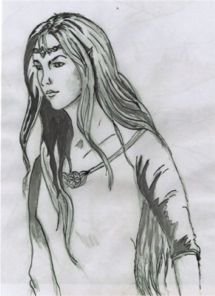

Nerdanel's Story

Silmarillion based fanfiction.

My Photo
Name:
Location: United Kingdom

I am a history teacher taking a year out to pursue other interests and courses of post-graduate study. This blog contains my first attempts at writing fanfiction, or any form of fiction. It is very much a working document and subject to many re-edits.What I write is based on the wonderful works of J.R.R. Tolkien, (edited by C. Tolkien), and is purely for my own pleasure and relaxation. I certainly do not do this for profit of any kind. Some chapters are at present submited to ff.net and 'The Council of Elrond' sites, although Nerdanel's Story is undergoing a lot of re-writing at the moment. There are many ideas and some names that I have taken from the 'History of Middle-Earth' series, so some terminology may be unknown to those who have just read 'The Silmarillion'. I am not an expert on Professor Tolkien, Quenya, or on writing, so I will probably make lots of mistakes! But as I mentioned, I am doing this for fun, and happy to learn as I go from those whose writings and thoughtfulness I admire. The avatar is one of my own sketches of Nerdanel.

Friday, June 08, 2007


Of the Redemption of Fëanor.


Yet again, apologies for not posting for so very long. My family situations are beginning to be sorted out, as my niece has a place for her Farrier's training this September. The rest of the family are reasonably stable. LOL

I have an exceptionally busy weekend ahead of me, with my wonderful Scottish relatives coming to stay. But by next week I should have time to myself again.

I have so much to finish editing! I have emails to answer; stories to read and comment on - Eluwë's, Eru_Melin's, Bellemaine's, Ellyns, Ellies...maybe another from Geek_Chick...I am sure there is more! My apologies if I still owe anyone emails or comments.


I am putting up a one-shot that is closely tied to 'Flame Rekindled'. Fëanor was the first to read it; and for ages only he, Eru_Melin and Bellemaine had seen it. I posted it on ff.net recently, and thought I would also put it up here as I have changed it somewhat from the original, and it gives some indication as to where 'Flame' is heading. I say some...because that story has now developed way beyond this one. But I really enjoyed writing this, and hopefully someone else will enjoy reading. Here goes!

The picture is part of our back garden. (Note to self: Must take more interesting pictures!)


Of the Redemption of Fëanor.

A/N This story is a one-off that I wrote a couple of years ago. As can be seen, ‘Flame Rekindled’ has developed out of ‘Redemption’. I am aware that some folk may not like this sort of tale, or would rather not read this one-shot, as it contains some of the further developments that feature in the main story – but it does not contain them all, and some matters in this version are not picked up upon in ‘Flame’. I hope that I have not confused anyone!


(Disclaimer: The characters and world they inhabit all belong to Tolkien. Only the interpretation and any mistakes are mine.)

With thanks to Fëanor for being the first to read and comment on this.


“For the price could be no other.”

(Manwë: on considering the answer of Fëanor to his heralds. ‘Of the Sun and the Moon’. The Silmarillion. J. R. R. Tolkien. Ed C. Tolkien. )


And so the Ages passed. In a manner all was the same – time and no time – past, present and future were as one. But I knew then the unique graveness of my deeds amongst the Eldar; the pride, which, while justified, had led me to accept lies without question, thinking them truth of my own device. I knew the greatness for which I had been intended. I knew, so pointedly, where I had erred, where I had become as a tool of the Marrrer. I, who thought to remain unbowed and unashamed, knew I had failed.

Such enlightenment pleased me not at all. That I, who would ever be master, had been mastered and used by the arch-deceiver; the murderer, the dark foe of Arda! Ai – such folly on my part – it was nigh unendurable!

Many matters had been nigh unendurable to me. But I was one who would never knowingly show weakness – was I not the mightiest of the Noldor? I would not add ‘craven’ to the list of my perceived character flaws.

Since being granted sight of the works of Vairë and of my mother; since being allowed those rare visits from my father, I had come to know so much more than anger, hatred and jealousy. Since knowing the role of Manwë and Mandos in keeping my fëa from the ensnarement intended by Morgoth I had become again one who paid heed to the Valar, who knew them not to be my enemies. In most matters!

The silence was no longer unbearable. Though there were instants when I was consumed with a longing to hear spoken word from warm and living flesh, rather than thought or memory; to hear laughter, to hear the beauty of music again - that which I most longed to hear was clear in my mind, and freed from taint.

“Beloved,” she had called me!

Even after all the grief and sorrow I had caused her – when I reached out to her at that moment I knew of Nelyafinwë’s death, and I realised she and I were not sundered in fëar as I had believed - she had, that once, called me “Finwion; meldanya!”

And we had understanding between us.

Even so, I never stopped yearning for restoration with my hröa; to be able to do, to be able to touch, to be able to talk and communicate again with other than Mandos and grey-cloaked Nienna; to be able to tell her, face to face, how wrong I had been.

For many Ages since that revelation Mandos had striven with me. So much time I had wasted in resistance, then in powerless regret. And had I not been intended by Eru to do so very much? To bring forth those devices of light that would have held back a space the tide of darkness the mortals were wrecking upon Arda - to show them a better way forward! I had not fulfilled my purpose. In my arrogance, I ran before I could walk – thinking my strength and skill a true challenge to the might of the Valar. Would that I had done otherwise! So I could do naught but come to terms with my failure – an understanding that would have been unthinkable when I walked the lands in hröa.

Thus it was that I endured in my jail – endured correction, healing; and learnt to embrace of wisdom. But still could I not be freed. At times I pondered if I even still wished it to be so. All had changed – all I dreamt of achieving had long been lost. All I loved – save her, save my mother – were in the same place of awaiting as I. Mayhap I should have stilled my heart further – to accept that there would never be release for me – that even the needful action upon which I placed my hope for short-lived freedom – the breaking of the Silmarils – could be done by another! I was not needed amongst my people or kin – I was not wanted – save by a very few. And were they not better off without me?

In the place of my fëa’s confinement I wandered at will – the seemingly endless, crystal-lit corridors, the tapestries of life that decorated the walls, I wandered amongst them mayhap for two ages or more. But eventually the tapestries became fewer – became less colourful – as a greyness, a barrenness was taken up in the weave that spoke of a doom which Arda could not long survive. I saw the visions given me of the time of Morgoth’s return, coming to be reality in both realms. Life in Aman – what I knew of it from the tapestries, had become nigh sterile, ever the same – day after day of unfaltering familiarity. Even those noble lords and ladies returned, they had not been able to stave off the growing ennui . Even my wise brother – even he of clearest vision and strength of character to see through the long years as esteemed king – he could do naught to prevent the slow withering of spirit amongst the Noldor.

The Valar themselves were tired – I knew! It was as if the foul and poisonous air from the Hither Lands had reached across the bridge of thought and light to weaken them. As if, with the passing of Ages - of the future of Arda becoming more firmly established - they were without purpose.

‘Wilt thou not send back my brother, at the least?’ I had questioned Mandos – two hundred – mayhap several hundred years ago. ‘Wilt thou not have the foresight to act upon thy knowledge of Morgoth’s plans? Thou doesn’t of certainty know the Music – thou doest know how he has ever brought discord to the Song thee and thy brethren gave forth before Eru! Send back Nolofinwë – that Arafinwë, Ingwë and Olwë make not this coming stand alone!’

But Mandos had answered me not on that occasion. And it seemed as if there was sadness upon even the Doomsman – that he said only that all was being done to thwart of the dark enemy and his followers. That through defeat would come victory – and a greater music thereafter.

Foolish words, I would once have thought. But I understood that at times, victory could be wretched from the edge of despair. That though existence in Arda Marred was ever a struggle against the long defeat – there were moments of hope sublime. Had I not been shown the power in hope – in a love sustained against all likelihood?

But I knew not if Nolofinwë had been restored. I spoke with him no more after that time we reconciled our past differences. Neither did I sense the presence of Turukáno – nor, of my own youngest son. But then there were many I knew to be in the place of awaiting whom I never had any experience of. And those few I saw as mist like wraiths, saw me not – nor heard nor acknowledged my presence.

So it was that I dwelt oft in those memories that most gave me joy. Memories of the early days; of my parents, and my father’s unfailing love for me - of the delight I had with her on our journeys together, and of our sons ridding with me across the wide expanse of Valinor. I thought on a house full of laughter, enquiry and jest – of the friends in Tirion who had never spoken me false – and of times alone – in awe of the creation which surrounded me, which I would seek ever to explore – to have knowledge of – aye, even to better!

I still thought of my Jewels. At times I wondered what, if aught, had further chanced them, but neither of the Valar spoke of them when they paid visit. Since I had come to the point of realising how I had allowed myself to walk, unchallenging, unresisting into the dark night of my spirit, I had found the call and love of the Silmarils to be a lesser thing to me.

Ai, but they were my heart! I wanted them back!

I wanted to look upon them again - to hold the three enchanted lights of undying gleam in the palm of my hand and know that all were in awe of them, and of me!

But a lesser thing were they become than the lives of my sons, so vainly discarded in pursuit of their oath; a lesser thing than the slaughter of my sire, trying to defend them from the thief and possessor; a lesser thing than to hold again in my arms the one whose company I desired in my solitude, and to know she wanted me still.

I still loved the works of my hands. The glory of the Silmarils was everlasting, but no longer was my heart in thrall to them. Or so, in my remaining folly I believed!

Since I had endured the purging of my guilt in what befell my people, in what befell the Teleri and others in the Hither Lands at the hands of my sons and followers, I found that resting in the shadow of my thoughts but rarely brought me pain. Mayhap, on occasion, the sea-like wail of the Teleri pieced my fëa; sometimes it was the memory of Nolofinwë’s face as he sought to follow me to doom. There were moments when I saw again the despair filled image of Nelyafinwë – a Silmaril clasped in his remaining hand, as he stood on the edge of a flaming chasm, and then stepped forward. At times I thought to see the Master Smith himself - Aulë, looking upon me with such disbelief that I would work against even him in my arrogance; and against that greatest of his servants, Urundil, her father. Aulë had never paid me visit – had never communed with me in any manner since I walked from his forge, believing him the liar whose words had taken from me my wife. Did he have any love yet for the one who so betrayed his trust, I wondered? At times I saw again the likeness of Manwë; sorrow filled at my decision to misunderstand his summons. That I had so stubbornly defied all his efforts to curb my hot-temper, that I could know of healing in Aman. And her; though I embraced the pain that accompanied any memory of her just to recall the love I lost and found - did I not sometimes hear her calling to me in that last of our encounters?

“Do not do this thing, Finwion! Even after such grief, after such an oath, thou canst find strength to recant. Even after speaking so vehemently against the Valar, of breaking the terms of thy exile may there be the possibility of forgiveness. Few would be strong enough to realise their error, and turn from it. But thou art strong enough! And whatever exile, whatever punishment the Valar deem fitting for thee, will I not also endure and willingly at thy side. Come back to me, Finwion, as thou didst intend.”

In thought alone I reached forth to caress her tear stained face. I would not seek of the union of our fëar that she knew more of the place in which I abode. I would keep her free from all touch with the seeming death.

Then was there the memory of he whom I once despised nigh as Moringotho; of Námo Mandos himself.

“For twelve years thou shalt leave Tirion where thy threat was uttered. In that time take council with thyself, and remember who and what thou art”

I had thought him my enemy; that he sought only to humiliate me out of fear of my growing power. How wrong could I have been! And how long it had taken me to understand Mandos was giving me chance to avert what followed. “Remember who and what thou art”, had he said! Had I done so at Formenos then mayhap the future would have been that ‘other’ song which he showed me. Though my doom was ever to be slain in the Hither Lands yet in that other future, which had been intended, would I have been slain amongst the forces under the Valar’s banners - and soon restored to be king in Tirion.

I, King of the Noldor, and accepted and acclaimed as such! What irony! But my freely made choices had shut all possibility of that path from my life, and from the lives of those I cared for.

There came a time in the place of awaiting when I realised I was no longer alone. Since my father’s visits, my reconciliation with Nolofinwë, and that occasion of gazing upon the still and slumbering forms of six of my sons, had I been without companion that I wondered at first if he were but an image Mandos wished me to consider?

A sense of familiarity there was about him; a sense that, embodied, I would have known his face.

‘Do I know you; did I know or love you in life?’ said I, aware, oh, always so aware that great love was the only thing that bound solitary fëar.

It seemed he drew closer in intensity, for he, like I, would of needs be a fëa unhoused.

A pleasing, yet sorrowful nature did he put forth; an image of very much power, but in a manner self restrained. Though his features were unclear to me, dark of hair would he have been in life; fair of face and strong of arm. But that which I sensed the most was music, as if he were the source of a great music.

Ai, thought I with sudden hope and anguish! It is my son! For my second son had never lain at rest with the others, and Mandos had answered not my questions as to his whereabouts save to say, ‘He understands better than thou, spirit of Fëanáro, of the will of Eru.”

‘Kanafinwë?’

If I had physical form my heart would have been pounding in eagerness; but as it was my thoughts reached out in longing to embrace the spirit of one I had thought long of; had loved, had missed.

‘Nay!’ the spirit replied, with a voice as rich and deep as my sons had been, and an understanding in that denial that his word would pain me further. ‘Kanafinwë is not in this place. I am not he, Fëanáro.’

After giving forth such an unguarded burst of vulnerability to one I knew not, I knew not what to say. But he was there. That spirit could ‘see’ me, had addressed me, and knew my name.

After so long without any other in reality, I, who was ever in life most eloquent, knew not what to say.

‘Why art thou in this place?’ my companion ventured to breach the awkwardness.

‘Do you not know? Which kindred of the Eldalië are you that you are drawn to me - speak my name, but know not my deeds?’

‘I know of thy deeds, Fëanáro. I have long heard of them. But that was not what I meant! Why art thou still in this darkness?’

I would have laughed at his question, but he was a companion - the first I had other than a Vala for a very long time. I would do naught to drive him from me.

‘I am not in darkness, and that due to the ministrations of the Doomsman of whom you must be aware. I am in this place of restraint, and not in hröa, because it is the will of Eru,’ said I. (I knew by then that Manwë would have loosed me if he could have so done. That he who was Lord of Arda would have overturned his own ordinances out of love for me.) ‘Manwë referred me to Eru for judgement because of my evil deeds. By my oath had I called down the doom of the Everlasting Darkness upon myself if I failed in my quest to reclaim my Jewels. I so failed. But Eru was not mine to command, to my good fortune and that of my sons. Though we are in this place of shadow, it is not the doom we expected.’

He seemed to ponder my words. Still was there a sense of sorrow about him, but like I, he would long endure. I began to think that Mandos had made some oversight in his administering of spirits, for here was one of good company who brought me much to consider.

‘Truly dost thou say that Eru is not thine to command, nor is Eru anyone’s to so do. But neither is it the will of the All-Father that any remain in darkness. Think not that, most grave and solemn though thy oath was, and in no wise lightly revoked - it was utterly irredeemable. Thou didst speak most ill that day upon the heights of Tirion, and other days also, yet did thou speak from a heart filled with anguish and loss, and a mind burdened with guilt at not having been there to save thy father from the Destroyer. Fey hadst thou become, that thy foresight failed thee when most needed, that thou didst think only of vengeance and pride, and not of life! Was it not ever the intent of the fell Vala to bring about thy destruction? This thou didst know! Yet think you that it is beyond Eru’s understanding?’

I wondered at his words with some annoyance, for none had ever spoken to me in such a manner. And I considered his being. Then it stuck me - the difference in fëa stuck me!

‘You are mortal - one of the Secondborn!’ said I. A statement of surety I made, though never had I actually beheld one of those whom I had once deemed to be so inferior; a cause for me to lead my people back to the Hither Lands. That was before I had seen the tapestries, had known of Beren, or of Tuor. ‘You are one of those Second Children of Eru, who inhabit the lands of the birth of my people even as the Quendi diminish.’

It seemed to me that he smiled; a smile of thoughtful concern at what I had said. Aye – he was mortal! I pondered that, young though he must of necessity be in years, yet was he one of the wise ones of his kind. For he carried with him a sense of great age, not bowed by weakness. I had understood the lifespan of the Secondborn to be a brief one in truth - as but several years. If that were so, then how did he get of such wisdom?

‘Tell me, are any of my people still in the Hither Lands or have your folk driven them all hence?’ I questioned him, Naught there was I could do, whatever his answer, but I would know. After so long of not wanting to see what transpired in the Hither Lands, I wanted to know!

‘The First Children of Eru are all gathered in the Blessed Realm, and there they dwell and abide yet in peace. Some few spirits of thy kind remain in that place thou dost call the Hither Lands for they will answer not the rightful summons of Mandos, but it is a land of the Second Children, and has been for many an Age.’

So ended yet another of my dreams! I felt no bitterness, for I had learnt that such a matter could be part of the will of Eru; and the reason for some things we may not know. Ai! At that memory of words she oft times spoke, I felt a sudden sense of her presence.

‘She would have liked to listen to you, visitor, for you remind me of the loremaster, Istyaro. Much was she, who in life was my lady, interested in the matters you speak of.’

‘In a manner she has oft listened to me’ he replied enigmatically. The sense put forth of his presence did not change. But something roundabout me was altering. I perceived not fully what it was.

‘You know of my lady?’

Now was I surprised! For a Secondborn to have heard of me was not beyond my comprehension. Surely tales of how dread I had become, of ‘Fell Fëanáro’ if not of the skilled creator of the Silmarils survived in some manner throughout time. But the Secondborn could not know of her. Not of my wise and gentle wife who had never left Aman.

‘I know the Lady Nerdanel,’ he replied. ‘And stubborn and wilful she can be. Yet I know also of her long and steadfast vigil for those she loves.’

‘The vigil for her sons,’ thought I with regret at what I had done to my family.

I could not answer my companion for a time. He seemed to withdraw from me, to let me ponder further. But still was his warm presence on the edge of my consciousness, as the cold presence of Námo Mandos oft was.

Strong had she been and undaunted by so much I had asked of her. Yet in the early days of my captivity I had thought to be summoned before Mandos, to be told she wished our union unmade. That she had lived alone in the unnatural state my father had not been able to endure and, at last, had found another even as he had, was ever a possibility. But when my mind cleared - and my memories of her cleared most swiftly - I knew she would never so do. I knew that for all my errors and rashness, I had chosen a wife wisely. So foolish had I been to be angry with that ‘estrangement’. What were the five years she had withheld her company from me compared to the Ages I had caused myself to be parted from her?

‘Why am I here, you asked? Because Eru wills it! Because none of the Eldalië may be return to their hröa unless they are willing to take up again the life they left. What would that life mean to me? No more the high prince – of certainty not the king! No works to craft, no lands to explore, no need to exist. And if I were ever to return, it is my thought I would again bring her of grief. After so long alone, she cannot think to welcome me as husband. Our sons - that is a different matter; she would want them all with her.’

‘And so she will have, before the End.’ My old-young companion was listening still to my thoughts, but I wondered what foresight he had to make such a bold assumption.

‘Thou art thinking of her good when thou dost wish not to be reunited with her?’ he continued.

I pondered for what seemed a few moments. ‘Mayhap that is the case? I long for her! My memories are filled with desire for her warmth. But I will do naught to willingly cause her further pain. Is it not the nature of love, to put the beloved before one's own needs?’

He nodded agreement, as if he were one of the wisest of the wise. But a Secondborn was he, and a new thought came to me that should have come first I realised he was no Elda.

‘You are of the Secondborn, visitor! This place, it is for the children of the Eldalië to remain in memory. The Jailer has been careless, for the spirits of your kind must depart from here and traverse the circles of Arda to come unto the presence of Eru. I shall rattle the bars of this cage of mine a little, son of Men, that my keeper may know of his mistake and take you hence to the place of light appointed for you.’

‘Thy concern is most heartening, son of Finwë, but there is no need’ said he. ‘I am in the right place.’

We sat in the shadow of thought for longer, he and I. I knew he wanted something of me to remain, yet knew not what it could be.

‘I wonder still why thou art in darkness, Fëanáro, son of Finwë; for thou art purged of the evil of thy deeds, art thou not?’

I was taken aback by his continued boldness. Who was he to command answer of me!

‘Should you not be concerned with finding your place amongst your own kind!’ I retorted. Never would I have taken such forthright questions from an Elda, or easily from a Vala. Who was this Secondborn to ask of one who had been a prince of the Noldor? Yet I found myself answering nonetheless.

‘The lies of Melkor I have unlearnt in great bitterness. I have taken council with myself, for far longer than twelve years, and I know who and what I am. Dear bought has been that knowledge. Though proud I still am, as is befitting one of my kind, I hold no grievance against any who now live, and am free of the possessiveness that possessed me.’

‘Thou speakest not truth, my friend!’ he chided.

‘How no? I have pondered long, and endured much to come to this point. That I have no love for Morgoth, is that my chain?’

‘There is one remaining trial for thee to endure; one thou hast sought to avoid in thy thoughts. A test of faith, if thou wilt, that thou wouldst do as thou dost say.’

His words were as a sudden fire that took hold in my spirit; a light and a flame that showed up the darkness in which I remained. Yet I stood not near the abyss, but bathed in a great and glorious light.

‘Thou art no mere mortal! Who art thou, stranger, that thou knowest me so well? No Vala nor even Maia could have such access to my heart and my thoughts.’

He answered not, but posed a question.

‘Another time of testing there was, and thou gave not over the Silmarils to the keeping of Yavanna, for the good of all. Though they were no longer thine, yet was thy heart hardened, and thy will set to add to the discord. Now I ask of thee - if thou didst hold in thy hands of this instant the Great Jewels of thy forging, the Silmarils themselves, wouldst thou give them over unto me, that I might break them?’

I saw them; so bright a vision that I could indeed have reached out and touched them. My heart’s love; my creations of sublime beauty. Give them to him, he had said! Not even, ‘give them to Yavanna’? I considered his words. I had thought my Jewels were of small importance to me, but mayhap I was wrong? Mayhap this was all some further trick of the Valar?

But a fierce fire was again in me; a flame rekindled that would brook no untruth. I beheld my companion in the manner of fëar that I saw through his semblance and perceived in him no deceit - I saw no darkness at all. Light he was – and Music! The thought was with me that he needed not even the Silmarils to so shine forth. Dawn broke on my long night, as I understood.

‘I am free!’ I said at last.

He smiled at me, for we both knew my unspoken answer.

‘Then claim thy freedom! None are there who will hold thee in this place. Neither do I hold thee here! It was decreed that Fëanáro should never leave the Halls of Awaiting, nor walk again amongst his kin. But I call forth Finwion, and he hears my voice. I call forth Curufinwë from the darkness into which he fell, that the fire set in him fulfils its purpose.’

And about me, and within - there was light.


- - - - - - -


Nelyafinwë – Maedhros
Finwion – Son of Finwë. Fëanor’s childhood name, and a name I write of Nerdanel using at times.
Meldanya – My beloved.
Nolofinwë – Fingolfin
Arafinwë – Finarfin
Turukáno - Turgon
Kanafinwë - Maglor

Labels:

Tuesday, April 17, 2007


The Fëanorieli

This is a bit of a departure from the norm for me - somthing meant to be funny! I have other pieces I must put up on here soon - but as ever, there is a lot going on in life, and I am trying to think through a particular situation. So here is a short nightmare of Fëanor's - doubtlessly prompted by Nerdanel asking about a daughter! ;-)
Drawing is a really old one of the character Naranel, from 'The Master Smith's Daughter'....or maybe it is Makalauriel? ;-)


The Fëanorieli

A/N This is a tongue-in-cheek one shot inspired by Merry KK’s review of ‘Nerdanel’s Sons’. on another site. I am using altered mother-names instead of father names, as Nelyafinwiel and Kanafinwiel were a bit of a struggle to get my thoughts around. I am not sure what ‘Ambarussa’ would be – so I have left it as is. While I think the idea is intriguing enough to develop as an AU tale, this ‘dream’ is the most my muse will allow!

(Disclaimer: The characters and story belong to Tolkien, I have only borrowed them briefly. Only the interpretation and any mistakes are mine.)

With thanks to Ellie.

- - - - - -

So had I woken to much noise in the house. They were arguing! Always did it seem to me that Tyelkorwen and Carniel were arguing over who should take precedence – over who should have the seat nearest the king at the forthcoming banquet – over who should have first the attention of Meldawen, the seamstress, or Arnónë to fix of their hair. Indeed, over which daughter of the High Prince - the dark or the fair - would look most becoming when attired for the following hunt.

Would that I could bury my head under the pillow and remain on the couch until their noise had abated. But was it not to me to sort out the problem? Nay – it was to their mother!

There was a knock at the door of my room. Without waiting upon my permission, Makalauriel entered – the bejewelled train of her sapphire blue gown trailing behind her as she came to stand by my side.

“Atar – wouldst thou give heed to the song I prepare for this coming celebration? It has taken me much time of pondering, and I would have thy view on its suitability for my grandsire.”

‘Should thou not have sung it to thy mother’ thought I – but ever the indulgent father, I nodded assent.

So did I hearken to a voice most beautiful – like the trill of the nightingale close in my ear, and of the joy to be had in babes!

Ai!!!

Would that my wife and I had not seven of our own! Would that Nerdanel restrained her passions but a little, and redirected them to her crafting in stone!

“Thy voice is beautiful, daughter mine – but for the benefit of King Finwë mayhap thy song should be one of content other than babes?

She looked disappointed. “Maitimë said just the same! She said I should have composed a livelier song that could be danced to. Much hope has she of dancing all day at the king’s house, for she says all of the lords find her to be most well formed in appearance that she will never lack of a partner.”

Enough!!!

Enough of matters trivial, thought I! Rising from the couch I hurriedly made way along the corridor to the study, out to the upper terrace and my workroom.

Curufinwen was already there – green sleeves rolled up, and raven dark hair drawn back in a single braid. She turned as I entered, but looked perplexed.

“Atar – this glass is faulty – I cannot see myself in it with the clarity I desire.”

“Later, daughter!” said I. “I will attend to thy mirror later!”

Then the twins were at the door behind me – as if to hem me in.

“Atar – tell Ambarussa that I am to ride the new golden pony first!”

“Nay, Ambarussa – I am to ride first! Mother said so!”

I ran from that place to find sanctuary from the nissi in my life – ran across the terrace to the stables, thinking to take horse – to ride awhile outside of Tirion, to ride anywhere I could find a place where I could have peace and clarity of thought.

But then was my wife calling to me!

“Fëanáro!”

I always paid her heed – when I was of a mind to. Nay, I always heard my wife.

Fëanáro – awaken!”

I could only wonder at what she wanted of me that she thought me not already awake.

“Fëanáro – ‘tis some form of nightmare thou art having, beloved! Awaken, I beseech thee”

And I awoke - with very much relief.

There was much noise in the house! Tyelkormo and Carnistir were arguing over who should sit nearest my father at the forthcoming celebrations to tell him of their latest exploits. Glad was I to hear their shouting – most glad to hear their deep tone of voice!

- - - - -
Fëanorieli – Daughters of Fëanor.
Nissi – She-Elves

Labels:

Friday, January 05, 2007


The Heart of a Dragon

This is a short one-off piece I wrote up today. It has been on my mind since I read the book by Verelyn Flieger - but a list of suggested story titles sent me by Ellie set me off on a 'must write' quest.

With this story it needs to be remembered that Melkor had darkened the thoughts of many of the Noldor. The shadow of evil lies on Nerdanel as well, and she is writing from a semi-decieved viewpoint.

Saying that - I am obviously likening some of Fëanor's characteristics at that time to a dragon with its hoard. The heart of a Dragon is - I think - one of greed, possessiveness and violence. I don't believe there were any dragons at the time Fëanor lived. Morgoth 'develops' them in the First Age!

On with the tale..any feedback is welcome.(I have a more positive one-shot sequel in mind!)

Picture? Well I shouldn't have posted it, because it is my rough copy of Nerdanel writing. A VERY rough copy with scribbles of others in the background. But Eru_Melin said post what you have done! I will finish this drawing properly and post it again. It makes a change from the Lake District and the Feanor doll! ;)


The Heart of a Dragon


Of Nerdanel’s thoughts on the departure of Fëanor to Formenos.


(Disclaimer. All is Tolkien’s. Only the interpretation and mistakes are mine. A/N. This piece was inspired by reading ‘Making verses Hoarding’ in Verlyn Flieger’s book ‘Splintered Light’. Kent State university Press; and also by an e-mail from Ellie. All other references are from The Silmarillion and Morgoth’s Ring. J.R. R. Tolkien. Ed C. Tolkien)


The house of Curufinwë Fëanáro. Tirion. 1490


So you move of your treasures from this house to a new place of keeping, my lord? A new, deep chamber you will build in the north in which you may contain all you hold dear – all you hoard unto yourself, all you desire to possess yet would deny to others.

Ai, it is true that for our sons and your father you make an exception – they alone do you permit to gaze freely upon your greatest works of skill. But now I begin to wonder if you count them as but part of the riches of your House?

They go with you! All of our sons and their families go with you. All of your goods and treasures do you take with you - save for one.

Even your father is now to be hidden from many others of the Noldor who would see and speak with him – safe in your fortress - in your dwelling place to be. The greatest of treasures is he to you, as all do know – and now you have what your heart has long desired - his uninterrupted company, and that none may steal of his time or affection from you. Nay – neither Indis, or your half-brothers, or sisters, or people may take your father from you.

The Great Jewels are yours you state! You are their maker; without your skill they would not exist. The Valar only want them as possessions of beauty; they would withhold them from the Eldar as they withhold light from the Hither Lands. Do you not withhold them, you who see yourself as the noblest of the children of Finwë – do you not see them as possessions to keep, to wear as you will? Of surety the light of the Trees is for all to live in, not to be locked away in safekeeping, not for wearing as an adornment, nay, not even for one as mighty as you!

How has your heart changed, my beloved lord - that you forget the light within the Silmarils is not your own? For good reason, with noble intent did you first craft them – and for the benefit of all. And you pored of yourself into that recombining of silver and gold that all were amazed at your skill. But you have come to love too well the works of your hands. You see the jewels increasingly as yourself – as your heart! So it is that the one who would possess of the beauty of light has become the one possessed.

Possessed of a hardening heart that fell deeds and violence matter not to you! Possessed of a tainted form of love – a greedy love, a selfish love. And have I not tried to speak to you, to give warning that any who seek to possess the light to the exclusion of others, do but lose sight of it altogether.

That pronouncement of Mandos’ upon you at Máhanaxar, you name it unjust, as indeed it is – but you welcome it! Save for the humiliation to your person, you welcome this exile. Seven days is the term Mandos has set before you must depart of Tirion. Yet you will be gone long before that passage of time. I will not go with you into exile. I will not be another of your treasures for you to lock away. I will not lose sight of the light, nor allow you to taint the love I have for you by further violence. And that my decision is not at all to your liking strangely brings me of joy! Though of late have our disagreements been many, you still wish of my company. Yet you do not seek to force me to leave, to possess me! Do we not still love each other, you and I? And that love one of the few things which remains untainted by the pervasive poison that mars so many of your deeds. Mayhap the armour you seek to encase yourself in has yet a chink that in time may let in the true light again? Mayhap then can I be fully with you, my lord and my love?

But for now, while you travel far to build of your fortress, while you keep guard over all that you deem yours by right that none may take it from you – remember that for a greater purpose than hoarding the light were you born. For a great and noble purpose I believe it was, and for the glory of Arda. Oh, my beloved Spirit of Fire – remember that, though as strangers we must now become, the heart that beats within you is yet the fiery heart of my lover and husband, of a Prince of the Noldor, of an Elda – not the cold heart of a creature spawned of Melkor's design, and of greed!

Labels:

Friday, December 01, 2006


The Fire and the Sea.

Part three of three.

This is the last part of this particular story. As I read through it I am struck by it not sounding as good as I would wish. I will probably re-edit it again in the future, but for now it will have to stand as it is. I am just too busy to change it again, and really need to be making progress with other parts of the story - and with study. Sorry! :(

The Fire and the Sea.


Urundil had made the ridge and was looking for the quickest way to the promontory Nerdanel now stood upon. Calling still, he believed she was beside herself with grief, over the revelations of Eärendil. “Gaerion; by the Valar, think of what she said of late. If you know aught of what has brought this mood back upon her, then tell me!”

There was nothing for it but to speak the truth. Gaerion also saw the lone nís, and fear struck him that she would cast herself into the sea. Never had he thought his words would drive her to such an action. Never had he thought she would suffer so much despair.

“I called her my heart’s-love. I said that I wanted to be with her.” It had to be that, at least in part. But did he not have to speak the rest of it also? “One thing did she ask of me, and that would I not give her. She asked me to forgive her sons.”

Ignoble did his refusal sound now he had spoken it aloud. Not at all did he appear to himself as he had imagined, when he had pondered on asking her to end her marriage for him. A wave of guilt swept him that he had not realised he had failed her, even as Fëanáro had failed her. Little different was he to her lord of old, for he also had put vengeance and hate before love.

Urundil halted momentarily to glare at him. “We knew your feelings. Why did you not speak with us first? We could have told you, my Lady Taurlotë would have told you. Fast bound was our daughter’s heart to the son of Finwë in life, and fast bound in death, it seems! She will not love another as she loved him; not even you of whom she is most fond.”

“Most dear art thou to me, Son of the Sea, did she say,” Gaerion whispered, almost in shame.

The Noldo did not reply, neither did he mention her sons; but his expression said all that Gaerion dreaded.

They had halted some way back from where she still stood, but it was as if she knew not they were there. No move did she make as she stared out across the wide sea.

“Let me have a moment, Lord Urundil. Let me speak with her that, mayhap I can undo what harm I have done!”

Though he was asking the smith to trust him with his daughter’s life, yet did Gaerion believe it was the only way.

“Nerdanel! Come away from the edge. Come home with me, and to those others who love and care for you,” Urundil called. But then seeing no reaction, he nodded to the Teler. " Do what you can, but with care.”

Slowly - so slowly did Gaerion walk forward. He unclasped his cloak as he moved and let it drop to the grass, for it would but hinder him if it were needful to make that jump after her, to attempt to pull her from the waves.

“If you have no love of life left, if all is but weariness and pain then step forward, and know that I will follow to save you if I can. Or if it is my presence, my ill-considered words that so torment you, then can I leave these shores with the fleet that carries the armies hence and return not to Aman, but to Tol Eressëa alone.”

He thought she must have heard him, for a small smile touched her lips. But it was not he she was thinking of.

“Finwion," she whispered in nigh soundless longing - as if recalling something spoken in ages past, something he had said to her. In but an instant her smile was replaced by a look of profound sadness. Her tone, as she responded to Gaerion’s words, was soft and clear.

“I am sorry, my friend. For I see now that I have given you false hope over these years; that I have hurt you as I would never have chosen to do.” She turned to face him, though made no move to depart the wildness about her.

“Fëanáro used to say that there are many kinds of love: that which he had for his father was one kind, for the works of his hands was another, and for his sons and I, yet others still. Not all were of equal value to him, neither were all equal at any given time. But he did love all!” She paused, grey eyes softening their focus, as she remembered further. “And he loved his mother, whom Finwë condemned to remain in the Halls of Awaiting through his second marriage. Whatever is decreed, never will I so condemn my husband! Though there was I time when I sought to be parted from him, now do I know my own folly. Never will I seek the unmaking of our union.”

Gaerion understood what she was saying. He knew the issues involved. It appeared to him that Nerdanel was again lost in some thought or memory for a moment more. So he waited. Always had he waited, but this time he knew what was to follow.

After a few moments, she sighed. “ I love thee Gaerion; I love thee well! But as a friend, as a brother, even. Thou art truly most dear to me. Yet I should not have so spoken. For to one only do I give my heart’s love; and thou art not he.”

The words hurt, though not with the intensity they once would have, for he understood. He had paused upon the cliff top, knowing in that moment that there was no real danger to her and that she had no intention of ending her life. She was there to think, to remember, and in that to be closer again to those she so missed. He knew that she was offering him the only form of love she could - as a friend. And if she could live her life without the one she most longed for, then so could he.

“Truly do you speak, lady. But I am more like him than I had thought. For I have lived these years with hate for my father’s murderer, and know that I would have become a murderer given the chance.”

She gazed at him directly for the first time that day, a look of compassion lighting her features.

“You would have slain Makalaurë!” she stated, though without any accusation. “You would have slain my son in vengeance. So do you see, in part, my reason for asking you to forgive?”

“Aye, my ‘everfriend’. I see most clearly.” He smiled at his own foolishness and held out a hand to her. Then at last did she walk away from the edge, towards him, taking hold of his proffered hand as she had done in her childhood. As it had been when they had played upon the shores and he had helped her across the rock pools, did it suddenly seem. But Gaerion knew those days were forever lost - save to his memory.

“And do I not know what the grief at having one of your family slain, and that one your father, can do? So I retract my request. That there is understanding between us is enough, Gaerion.”

“It is not enough!” he interrupted “I shall seek your sons in the Hither Lands for their own sake, and for mine. Though of now I cannot conceive of entreating for any of them to the Valar, yet do I hope in time, I will change.”

She took up both of his hands to her lips, her face lit with a rare beauty and her complexion flushed with warmth. “Of noble and generous heart art thou, my friend.”

Seeing what had transpired, Urundil moved to stand with them. The unexpected words of the Teler echoed in his heart and struck at his own need for vengeance, as he thankfully embraced his daughter.

“Atar! Sorry am I to have concerned you, and to have been not about my work,” she said “But I needed to be away with my own thoughts for a short time. These words of late from the Hither Lands, they weigh heavily upon me.”

“Yendë! I feared for you, for your well-being!” Urundil released her from his grasp. “I feared that this latest revelation from Eärendil had pained your mind so much that, in despair you sought to cast yourself into the sea.”

“Nay, father! Better than that should you know me! No honour is there to so do if one is in their right mind. And at least one of the House of Fëanáro will ever seek to behave in a manner that is pleasing to the Valar, and to Eru Ilúvatar.”

So a sense of joy in life touched both neri, that she who they cared so much for was yet undaunted. Back to the horses they walked, in a new mood of relief.

“And I do not despair, father.” Nerdanel had that slight smile upon her lips again, as if she knew something that hitherto, she had not. Gaerion made to help her mount and she nodded to him graciously, accepting his offer.

“There is still hope! While I think that Makalaurë will not return from the Hither Lands for some time, yet does Maitimo also live.”

The Noldo smith and Teler walked forwards at the side of her mare, making to that place where they had left their own horses. They did not notice the strange look that momentarily lit her features.

“We know not all. There are some things hidden even from the Valar in the will of Iluvatar. Aye; and even should Maitimo perish, is there hope!”


- - - - -


Urundil - Sarmo Urundil / Mahtan. Nerdanel’s father.
Aulenduri - Servants of Aulë
Aldëaosto – Tree-shadowed town, I think.
fëa - spirit
Turukáno - Turgon
Arafinwë - Finarfin
Ambarussa the elder - Amrod
Maitimo - Maedhros
Makalaurë - Maglor
Moringotho - Morgoth
Nolofinwë - Fingolfin
Yendë - daughter

(1) ‘Of the Flight of the Noldor’ The Silmarillion. JRR Tolkien. HarperCollins Ed. p 91

Notes on the marriages of the sons of Fëanor. In a footnote to 'Of Dwarves and Men' in 'The people's of Middle-Earth', (HoME 12), it says that Maedros appears to have been unwedded, also the two youngest. Celegorm also, since he plotted to take Lúthien as wife. But Curufin was wedded (though his wife did not go into exile with him). Others that were wedded were Maelor (Maglor), Caranthir. p318 HarperCollins) I realise this is a very obscure reference.


I sometimes switch between the polite ‘you’ form of address and the more familiar – or affectionate –‘thou’ according to the situation between the speakers. ( Notes 5 and 19 ‘Athrabeth Finrod ah Andreth’ Morgoth’s Ring J.R.R. Tolkien.)

Labels:

Thursday, November 23, 2006


Awed in the Presence of Beauty.


Another short, one-shot today. I am still re-editing in a frenzy at the moment, because I would like to put up the chapters of the newer version of Nerdanel's Story in quick succession. There are some alterations to what I previously wrote in the actual story line - though I think I have retained the style and basic ideas. But I am trying to show Nerdanel as a bit more hopeful of some happiness than previously. I am trying to show that she doesn't think that Eru will keep all of her sons from her until the End. (Those of you that know this story will probably realise I am thinking of Ambarussa the younger.)

But today is Thanksgiving, so I would also like to take a moment out to wish my U.S. friends a very happy day. :)

Even I, in rainy old Blighty, had roast turkey and cranberry sauce today!

And a visit to the osteopath may have discovered the reason for the migraines! Here's hoping! ;)

I may have used this picture before - blame it on the sudden excitement of having access to showing photos again. It is of Crummock Water, looking towards Buttermere; the Lake District, Cumbria. We have had some great times there.


Awed in the presence of beauty


“But the Quendi shall be the fairest of all earthly creatures, and they shall have and shall conceive and bring forth more beauty than all my Children …”


(Ilúvatar: Of the beginning of days The Silmarillion J.R.R. Tolkien. Ed C. Tolkien. HarperCollins p 35)


With many thanks to Ellfine for beta reading.


He stirs restlessly on the bed beside me, eyelids flickering over open eyes as he endeavors to make sense of the images given him in dream.


So beautiful is he to me!

I have already known much of beauty in my life. Is it not part of being of the Eldar? Is it not something we ever seek to show forth - to sub-create, to conceive – Ilúvatar’s gift to us? There is much beauty inherent in our people, in the creations of our hands and minds. But never before have I fully appreciated how utterly awed by physical beauty one can be.

Oh, the light of the Trees is truly a wonder to behold, and the Valar in the forms they take to walk among us are nigh indescribable in their radiant glory. This blessed land in which we live, this cleft of light; it is an astounding place all too easily taken for granted.

And I have known great beauty in individuals before. Of a certainty have I – who am not amongst those most notable for their appearance - been blessed with knowing that! But as I watch his face, his form, he is beyond all my expectations.

As I watch him closely, his restlessness increases, head turning from side to side, arms moving, fingers spreading open, seeking to grasp hold of something, as if he would be about some work of craft. I reach out most gently to touch him; concerned least my movement breaks the enchantment that holds me fast.

I would not break the hold he has on me. Nay, even though I am exhausted from all he has demanded of me these last few days, yet I cannot take my eyes from him and seek rest for myself.

I want to keep watch over him!

Soon he will be fully conscious, and my time will be his to command. But how can I deny him that. I cannot deny him anything he needs or desires. So full of love is my heart that I am awed in his presence.

Again, the sudden movement, the focusing of his eyes upon me, that I draw him comfortingly close, feeling his warmth as he nuzzles against my cheek, my neck – my breast.

Something of my appearance he may have, yet it is an ordinary beauty crafted into a form of perfection that only his sire could have bequeathed him.

My beautiful one!

My firstborn babe …

My Maitimo!


- - - - -


Maitimo - Maedhros

Labels:

Tuesday, November 21, 2006


The Fire and the Sea


Part Two of Three.


(With a picture of some of the Norman knights about to charge up Senlac hill at the battle of Hastings, if anyone is interested!! )


Gaerion was distraught in spirit. He had so hoped his recently renewed acquaintance with his childhood friend would lead to an increase in both their happiness - to something more permanent. Not that the Teler was unaware of the feelings Nerdanel still held for he who had been in life her husband. But Fëanáro was gone in a manner most grievous. In the Halls of Awaiting was he and unlike others, not to return, it was said. So had Gaerion allowed hope to grow again, that this nís he had long admired would one day look upon him as more than a friend.

“Most dear art thou to me, Son of the Sea,” she had said the previous morning, as they had walked together in the first light of Vása to the herb gardens she intended to work in. “For thou hast stood by me and by my parents in these recent years, seeking only our joy and little for thyself. Though many of thy people have long shunned the company of the Noldor, and for good reason, thou hast sought reconciliation between our kindreds. Most generous of heart art thou, Gaerion. Yet is there something more I would ask of thee.” She had reached up and touched his face lightly with her small, elegant hand; after so long, that touch he desired above all others.

“Ask what thou wilt, and it is thine, my lady. For most pleasing are thy words, and thy tone of address. So long have I wished for thy favour again.” He had spoken heartfelt words, but without thought. Disarmed had he been from his usual caution by the familiarity and tenderness in her voice.

“My favour?” She had taken from him the basket of tools he had been carrying for her and turned to that area in which high, green and silvered fennel grew.

There was something she wanted of him, and was there not also something he wanted of her? So desperately had he wanted to ask her to seek a sundering of her marriage to Fëanáro. Surely, if she so willed, the Valar would grant her such? No fault of hers was her long widowhood, save that she had chosen the wrong nér to be her spouse. Gaerion had hesitated to be so bold. And yet his heart would be not restrained! Encouraged by her open gaze, her unreserved demeanour as she knelt upon the grass to better examine the plants, he had made to speak more intimately than the situation warranted.

“Aye, my heart’s-love. If I am truly dear to thee, then mayhap thou wilt allow me the privilege of being at thy side more often. For when I am away from thee, my world is but dimly lit.” He had knelt close beside her, as if even that difference in stance was too great. But what a poor choice of words, he had suddenly thought. Fëanáro would not have fallen into that trap. Ever had he been most skilled in the use of words.

Nerdanel had made to raise her hand, to touch him again, but she had halted mid-gesture. Then was there a look of dismay upon her face, as she sat back upon her heels.

“Gaerion, my friend, you misunderstand!” As she shook her head, her loosely braided hair caught the light of the sun, setting its copper-red glints as a halo of flame. “Please, forgive me! For I should never have spoken to encourage you in such words.”

He had not understood! What had he done wrong? Surely she knew his intentions, had indeed suspected them for many a year? She must have known he loved her in his youth, before the son of Finwë had come upon her in the hills and taken her from him. She must have known that he had loved her; despite the atrocities he had born witness to, despite what her family had done to his.

He made to take up her hand. Though he noted she had not used the more affectionate term of address to him, he persevered. “If it is still too soon to so speak, I also am sorry. But know thou that I will wait upon thee. That though he who was in life thy husband, and those many of thy sons do not return; though hope for them is gone because of their deeds, always shall I be here for thee.” Comfort! He had meant to offer her comfort!

Abruptly had she withdrawn her hand from his and risen to her feet.

Still is Fëanáro my husband!” her words had been spoken pointedly. “And always is there hope!”

The day had seemed chill of a sudden, and Gaerion had realised how very silent the garden had become. No sound from those at the forge or the house was there, nor even that of birdsong or of crickets chirping in the grass.

He had hung his head in shame at having so distressed her. ‘Too soon,’ he had thought. ‘I have spoken too soon!’ But there was still her unasked request; still one chance to redeem himself.

“Lady Nerdanel; you said there was something you would ask of me. Then ask! For if it is within my power will I not do it?”

She seemed to ponder his words for a few moments, her frown softening as she made to smooth out the folds in her grey gown. He had made but slowly to rise, stepping back a pace from her. Waiting! Always, he realised, had he waited for her.

“I know not if you will do it, Gaerion!” Her grey eyes held his as she looked up at him, and then deep into his heart, as she had never done before. “For what I would ask of you is forgiveness for my sons. I would ask for you to entreat Manwë on their behalf. Not for my sake, but for theirs; mayhap even for your own.”

He had been unable to answer immediately, but had sighed most deeply and broken from her gaze to stare at the ground. Anything would he have done for her, whether she would have him or no! He would carry her sons back upon his ship; he would do so willingly, but for her sake, never for them. What she asked; it was too much!

“Makalaurë slew my father,” he stated dully, as a well-rehearsed reply. Not that this knowledge had been new to her, for she had long known what details he could tell of the deeds at Alqualondë.

So she had turned away from him, pale of face, her own head lowered in disappointment. The sadness that enveloped her was so great that it almost broke his heart.

“I am sorry, Gaerion,” she had said, as she walked alone, back towards the house. “So sorry to have spoken of this matter to you, and reminded you of your pain.”


- - - - -


As they made the ridge, the most spectacular view of the bay of Eldamar and of the city and harbour of Alqualondë itself, greeted them. Gaerion slowed his pace to that of Urundil. As he walked side-by-side with the grandsire of the kinslayers, his thoughts turned back, unbidden, to that day of woe over five hundred years earlier.

“Forgive them,” Nerdanel had asked. How could he forgive?

The sea -- it was blood! Ai, the sea at Alqualondë, it was all blood!


- - - - -


Gaerion, as many of his people, had been distraught beyond words at that sudden and unexplained darkening of the sky. The Teleri had been about their business; on the shores, in their homes, sailing with carefree joy upon the waves of the sea when without warning they saw the light of the Trees was no more. The Sea-Elves had lived mostly under starlight in their city, but always had the glow of the primordial light been visible from the eastern end of the Calacirya and upon the mountaintops. Always were they free to visit the lands beyond the mountains, and bathe in the fullness of the light if they wished. No more! Yet was it worse than the darkness of any sky ever known to them, for this darkness ate into their minds and their hearts, as if to consume them. A wail had gone up, like unto the cold cry of gulls; of confusion, of distress - and that sound must have carried from the silver shores up through what had been a cleft of light, to the place of the High Festival upon Taniquetil; to the feet of Manwë himself.

At the time of the darkening they had been returning to harbour upon the Uinenlindë, Gaerion, his father and his brother. Some of the crew had been as shocked as any upon the land, though they had not cried out.

“Whatever has happened,” Gilfanon had said, “trust in the Valar! We trust in the might and in the wisdom of Ulmo to prevail.”

Captain and crew had all bowed their heads then, and still hearing wails arising from the city, they had silently beseeched the Lord of Waters, Ossë and Uinen for their aid. Gaerion considered he would not be the only one to give thought to their Noldor friends who, from the location of the festival doubtlessly felt more keenly the darkness than they.

The air seemed cold and chill as the ship made harbour and downed anchor. A mist there was arising from the waters that slowly covered the land, even heading along the southern inlet of the Shadowmere that led to Tirion. Many of the mariners of Alqualondë were heading from their homes towards their ships, with families in tow and what provisions they could gather in their arms. A cacophony of sound had greeted the Uinenlindë’s landfall, and for a moment those on-board sensed that fear had almost gripped the hearts of their free-spirited kin. Safer did they all feel at sea in this danger, this unexpected change in the stability of Aman. Yet within moments that mood of flight was halted.

Upon the harbour wall Eärtur and Ëarcáno, two of the sons of Olwë stood, bearing each aloft one of the blue and white lights gifted to them by the eldest son of Finwë so that all could behold them and that they did not fear.

“Do not so rush, noble folk! Do not give way to despair,” the calm voice of Eärtur cried out above the noise of departure. “I know you would seek the familiarity of the seas in this moment of confusion, but think upon Ulmo, and on how he has never betrayed us. Think on his might! What is this that happens, that we should now have such lack of faith? “

Many halted their rush to the ships and a few gathered by the wall upon which the brothers stood. Their voices carried in the renewed silence along the jetties where the fleet was moored, and to those of Gaerion’s ship.

“We understand the sadness and confusion at this loss of the light,” a second voice stated “But my father bids us remind you that the Valar are able to redress any hurts that might have befallen this land, and that this ‘night’ will pass unto a new dawn.” Ëarcormo, always of a most reasoned voice, added to his brother’s comments.

“Return to your homes or to your ships, as you would do had naught come to pass. And ever beseech the Valar, that they will overcome this darkness for us. That Aman will be again as it was.”

More words were said, but with less force, and soon enough had much of the crowd dispersed. Many returned to their homes as bidden by their princes, and in calmer spirits. Though still was there some talk of darkness entering hearts, did most seem content to remain in their city.

It was reported to Gilfanon a short time later by those walking along the quayside, that King Olwë himself had come out of his mansion and walked amongst his people. He had walked and spoken comfort where he deemed it needed and assured all that he interceded with Ulmo, and with Manwë, and that no great threat was there to any.

Gaerion had remained upon the Uinenlindë with his father alone. (For his younger brother, Gillondë, had gone ashore to find and reassure their mother and his wife, and many of their crew had also sought to reassure loved ones.) They had partaken of a small meal of fish and of bread, though neither had been in mood to eat. Neither felt in mood to leave the ship either! So some hours passed, and no change, no touch of light appeared behind the mountains.

“The Trees are dead!” a returning crewmember spoke forlornly, “else light there would be by now. Murmurs there are that this is the doing of Melkor!”

Hard was that to accept. The light of the Trees was part of what had drawn the Eldar of all three kindred to Aman. To gaze upon the beauty of Light was the reason many had made the westward march. And now it was gone? The darkness took on a new depth of oppression at that knowledge, although the stars of Varda still twinkled in the sky to the east and the white summit of Taniquetil was again visible.

The crewman, Falmarin, joined them for a goblet of warmed wine, but most sombre of expression was he. He but nodded, when Gilfanon asked if his family on-shore were well. Again many hours passed and the gentle rocking of the ship lulled the three almost into a false sense of calm.

“Go ashore, Gaerion,” Gilfanon had eventually said. “No good does it do us to be so confined when we know not how long this state of affairs will remain. Go ashore and visit with your mother. See if you can find aught else to inform us of what has transpired.”

Gaerion had at first protested that his father should go, but Gilfanon would still not leave his ship. Then came the first of the dread news! Rumours only to start with, and passed from ship to ship by those who had remained in the harbour.

‘King Finwë is slain!’ the whispers of disbelief passed amongst those Teleri still aboard their ships. “Melkor it was who destroyed the Trees and he has slain Finwë, king-in-exile at Formenos.” The message had passed, and information been added like a dreaded fire. But another fire there was coming - had they but known it.

Gilfanon had been most grieved at the news of the death of the Noldo king, though in truth was Nolofinwë then king; his father unwilling to meet with his people while his eldest son was banned from Tirion by the Valar. “Olwë will be greatly saddened at this news. They were friends from the earliest days, from the Hither Lands, he and King Finwë. Was it not the prayers of Finwë that drew Olwë and his people unto this place?”

Gaerion pondered his father’s words, though his mind was focused on another of the Noldor. Then Gillondë returned.

“Mother is content to remain on the shore, and Elwen will keep her company. She has taken to heart King Olwë’s request for calm. But the Noldor are here. There is a group assembling outside the city walls even now. It is said in the streets that Prince Fëanáro, nay, King Fëanáro after the murder of his sire, is speaking with our lords and others, and about us all leaving these shores and returning to the Hither Lands.”

Gaerion’s thoughts had turned then to Nerdanel with a vengeance. Was she here, he had wondered? Was she even now outside the city walls, reconciled with her husband in what could only be his grief and madness at such a suggestion? He had known the daughter of Urundil was estranged from Fëanáro in recent years, but also he suspected that her love and understanding would draw her back to her husband in such a situation as the death of his father. But Fëanáro wished to leave Aman! And the enormity of what had befallen began to sink into Gaerion’s heart.

“What of Nolofinwë? Is he no longer king?” Gaerion asked of a sudden.

Gillondë shrugged his shoulders. “I know not! Only that Fëanáro is here, claiming kingship. And he speaks on the concourse before King Olwë’s house for any and all to hear. With much passion and eloquence does he speak, and to encourage us to seek new lands to the east wherein we may govern at will. But none will go with him, I think. For though the leaving of the Noldor will be a sorrow, what need have we of other lands or lords? And still do we trust in the Valar, rather than in our own might.”

“Mayhap we should prepare to sail again, nonetheless?” Gaerion had jumped to his feet with an almost Noldo-like longing for action, and headed onto the deck. That something transpired near the king’s mansion was evident by the number of torches and lamps there assembled, but otherwise, all was as it had been. The stars to the east glittered in the sky, and the heavy darkness of the Calacirya remained.

“We will wait upon the king and upon Ulmo, my son,” Gilfanon had called after him. But Gilfanon had not the experience of Fëanáro that Gaerion had.

That waiting; those hours of pacing the deck of the Uinenlindë while the glory of Alqualondë remained and the blood stained streets and harbour side were not yet reality, it lingered as a pain in Gaerion’s fëa from that time forth.

Then, just as he had returned to silent pondering with those others below deck, sound of shouts, of adamant protest had risen. A cry to desist an attempt at boarding a ship echoed through the still air, to be shortly followed by the sound of a struggle, and someone being thrown into the water.

“What now?” Father and sons were on their feet as a returned, pale haired mariner put his head through the door at the top of the steps that led to the hold.

“The Noldor want our ships! They intend to take them by force!” The nér’s face was almost as white as his hair, and with a mixture of shock and outrage. “Quickly! Defend the fleet!“ With a beckoning gesture he departed their sight.

They had followed, and nothing could have prepared them for the sudden onslaught of noise, the shouts and curses of neri fighting, and dying, that met them. For the Noldor were upon them in force, and desperate were they! Armed with terrible, long swords were they!

The Uinenlindë was moored at the sea end of the quay and already they could see two swan ships, cast off, and heading for the misted harbour entrance, one with Teleri and Noldor still locked in a deadly conflict. But the battle on the quayside was now in the city also, and the Noldor were not prevailing without cost. Lightly armed, with knives, short bows, and but a few spears and fewer swords, (those given them by Noldo ‘friends’), were the Teleri, but also were they brave of heart in defending what was as dear to them as their children.

Gaerion and those of his family aboard could have fled; their ship was nigh ready to sail again. But none of those three neri would leave their people, leave those who were wife and mother, to this onslaught.

“How can this be? What could possibly have caused such evil in this place? That Elda slays Elda, it is a thing unknown!” Struck by the horror surrounding him, Gaerion had thought it was the end of the world.

Then, out of the growing mists that snaked, long of finger into the harbour, a group of armed and lightly armoured Noldor were nigh the Uinenlindë. Gilfanon drew his hunting knife, the only weapon he had, and made to bar their way.

“What is this, that the Noldor have become murderers? What of friendship and of the invite to live side by side in this land, even as close kin?’

“Yield the ship, Teler!” From the midst of the group, a tall and powerful dark haired nér strode forth. Unhelmed was he, and a light as of flame burnt fiercely in his eyes. The blade he wielded was grim and fell, and he made as if to strike.

Gilfanon could not match him, not with a hunting knife nor with any other weapon! Yet neither would he give over his ship. He stood defiant upon the deck.

“Never will I yield my ship, not for friendship nor most certainly for force!”

But the Noldo seemed to be focused on some instruction, on some deed he must accomplish without thought, without rationality or conscience. Gaerion made to aid his father’s defiant stance. And he called into the noise, to one he had met before, to one of the four of the seven sons of Nerdanel that he had known.

“Makalaurë! Hold! Do not do this thing!”

But he was too late. His father’s body, pierced through with fine-crafted metal, fell dead into the waters he loved.

“Nay!" Gaerion had cried in vain.

Then Gillondë rushed past him, his knife drawn, only to be pushed aside as the second son of she for whom he had been so concerned made to board his father’s ship. His ship! And Gaerion knew what he had to do. He ducked the first blow aimed at him by another of the Noldor, and darted back into the hold. The sword! He would take up the sword he had promised himself never to use. Fumbling with urgency amongst the items stored in his locker, he felt the touch of the leather scabbard in his hand, and, drawing the blade, headed back to the deck.

The sea was red with blood! Ai, the sea was red! Bodies of Teleri and Noldor alike floated in the water, and littered the quayside. If he had thought the Teleri could prevail, for there had been at least one successful rebuttal of the attackers, he now saw a new host of Noldor, fresh to the fight, and running through swirling mists to the aid of their kin. Only one thought did he then have, and that pounding irresistibly in his mind. He would bring down his father’s murderer; he would find that son of Nerdanel - nay, of Fëanáro, and end his life there and then. A rage filled the normally gentle Teler the likes of which he had never known.

The Uinenlindë was taken; there was nothing he could do to prevent that. He saw that the anchor was being raised and the mooring ropes recoiled. On the quay, Gillondë lay upon his back, open eyes staring at the stars overhead for which he had been named, but which he could no longer see. Falmarin also lay gravely wounded, his bow beside him that had never fired a shot. No time for grief was there, only for anger! Gaerion saw the dark-haired Makalaurë moving on to a further ship, blood-soaked sword in hand; the killer, the slayer of friends - and the distraught Teler made a leap back onto the quayside, even as the oars were being manned, to pursue his enemy.

“Murderer! Kinslayer!” he had called after the advancing figure. He had seen then that Makalaurë had moved swiftly to cover the back of another, even taller, Noldo. Another of the brothers, 'Maitimo', he thought, as that one had hair lit to flame mingled with blood in the lantern light. Determined to bring down his father’s killer, Gaerion was almost impervious to the presence that was suddenly upon him from the side. He raised his sword, defensively, just in time to deflect a downward stroke. And his heart nigh quailed within him. For between he and his goal, armed and armoured, in full strength, in full hate and rage, was Fëanáro himself.

Never could Gaerion quite recall what had happened. That he had awoken, face down, upon the beach to the south of the city was the next clear memory. He knew he had striven with Fëanáro, that in his anger over so many things, he had wanted to kill. But he had not!

“More noble neri are there amongst the Teleri!” the Noldo king had said to him bitterly, and with but one flashing movement of his own sword, had disarmed him. Gaerion had not understood Fëanáro's reference, but he sought to grapple with the one who was surely responsible for the mayhem. Yet was Fëanáro stronger by far, and had brought him low not with his sword, but with a resounding blow to the head; then thrown him, dazed as he was, into the water.

Had Fëanáro let him live? Had he who was in a blood-rage, prevented Gaerion in his hate from being likewise? The Teler could not quite believe there had been any compassion, any conscience in Fëanáro’s heart that day. That his sons had gone to the slaughtering of innocents with unfeeling hearts of their own; that many of the Noldor, save those to the rear of the hosts, those with Arafinwë, had been part of that slaughter, would never be forgotten. But ages had taught Gaerion that the kinslaying had not been as straightforward a matter as he had first supposed. And over time, had some of the Teleri tried hard to forgive the Noldor that most awful grief. But he could not forgive! Nay, not even for her sake could he forgive.


(Notes at the bottom of part one.)

Labels:

Sunday, November 12, 2006

Safe!

I am safe, thankfully..but I have not managed to escape the migraines. Because of that I haven't done as much writing as I had hoped, so I am putting up a really short piece today, and will try and post the second part of The Fire and the Sea tomorrow. I will also try and get my e-mails and PMs replied to tomorrow. Sorry yet again! :(

Safe.


(Disclaimer: All belongs to Tolkien, except any mistakes.)

With many thank to Ellie for beta reading and encouragement.

Early thoughts upon the release of Melkor from imprisonment


It was not through fear, but through great desire for the light of the Trees that those who are now our kings led us hence. No cowardice was it on any of their part, no yearning to flee the land of their birth. It took of courage to make that long, slow journey into the uttermost West, with the dark clouds of the ruins of war still obscuring the northern stars. Yet the fact remains that, here, in Aman, the Eldar are safe.

So why is there now this disturbance – this calling to council of lords?

What is there for any to fear? Surely Manwë knows well what he is about in granting Melkor pardon?

There has been talk. Some who made the great march, who remember life under the starlit expanses of lands to the east, speak again of their memories. Some say that Melkor’s deeds are beyond forgiveness. Vala though he is, they trust him not at all! King Ingwë, King Finwë; they trust him not at all!

Yet Manwë Súlimo, he is King of the whole of Arda - he understands most clearly the purposes of Iluvatar, the wise do say. We can ever put our trust in him.

My parents speak but rarely of the time before they came to Eldamar. Nevertheless, others speak openly of the shadow-shapes that walked the hills above Cuiviénen, of those of their kin who were ensnared by the servants of Melkor, never to be seen again. Arnónë did tell me the tale of her own father, of his disappearance into the woods on a hunt from which he never returned. Though she, her mother and her brothers made long search, never were they to know what had befallen him.

“We dared not venture far abroad to hunt or to explore,” she told me “Though we could be light of heart in our youthful innocence, there was also the creeping fear of the dark Rider that the Quendi once lived under.”

“Mayhap it was true of the Avari, but our people are brave of heart!” I protested. “All three kindred are far from craven!”

“You know not fully of what you speak, my lady,” she answered. “Those born in Aman understand not what it was like to dwell in the Hither Lands. There was a dread that could griped the very fëa until doubt and mistrust - seeing in the shadows threats that were not there - weakened even those amongst the strongest. Why, many of our people fled when first they beheld Oromë! They fled from his presence into the deepest darkness, and were lost to us. Deceived they were by the lies put abroad by Melkor, that they knew not friend from enemy.”

“But the noblest were not deceived! Not those of great courage – not Finwë! They were ever drawn to the light!”

I dounderstand what she says. I trust not Melkor myself. But what have I to fear? Melkor is still under guard, still confined to Valmar, is he not? The Valar watch him most closely. And I trust our king’s judgement in most matters; his ability to lead us aright in whatever situation comes upon us. I trust also to the subtle mind and might of his son. Though none of us are a feared of the unknown, here in Aman we are safe! My sons are safe; I am safe – I who take of rest in the arms of Curufinwë Fëanáro.

Labels:

Thursday, November 09, 2006

The Fire and the Sea.


Part one of three.


Now I am finding I have so many ideas I can't get them all written down in time. I am trying to add to my notes as I go, in case I forget, but that cuts down on actual writing time.

I need to leave reviews on a couple of stories I have read on ff.net, and return some e-mails..I AM catching up now.

The other thing that holds me back is the dreaded e-bay! We have decided to decorate our 1930's house even further in a 1930's style, and there are just so many things to be found on e-bay! :) We will keep all of our 'modern' conveniences, of course..no going back to a coal fire in each room, or a tiny larder...but will try and blend them in a lot more.

This story is a re-write of one I did ages ago. I always thought it rather long, so I am posting it in three parts.


The Fire and the Sea


(Disclaimer: All characters, places, and the main story line belong to JRR Tolkien. Gaerion, Gilfanon and Gillondë are my characters inspired by reading Tolkien’s wonderful works. All references are from The Silmarillion and HoME, Volumes 10 and 12.)


“But the hosts of the Valar prepared for battle; and beneath their white banners marched the Vanyar, the people of Ingwë, and those also of the Noldor who never departed from Valinor, whose leader was Finarfin the son of Finwë. Few of the Teleri were willing to go forth to war, for they remembered the slayings at the Swanhaven, ….and they sent mariners enough to sail the ships that bore the host of Valinor east over the sea.”

(‘Of the Voyage of Eärendil’ The Silmarillion. J.R.R Tolkien. Ed C. Tolkien. HarperCollins. p 301)


“There (The Halls of Mandos) long shall ye abide and yearn for your bodies, and find little pity though all whom ye have slain should entreat for you.”

(The Prophecy of the North ‘Of the Flight of the Noldor’ The Silmarillion. J.R.R. Tolkien. Ed C. Tolkien. HarperCollins p 95)


The Year of the Sun 544. First Age. A coastal path north of Alqualondë.


“She will have gone to that place just north of Alqualondë where the coastal trail comes to an end at the cliff’s edge. A sheer drop it is, onto the rocks and waves below. In her present mood I know not what she will do!”

Urundil was distraught. Silently he beseeched Aulë’s guidance, wishing that Tulcon, Narwasar or Artaro had been at the dwellings of the Aulenduri to accompany him on his urgent pursuit. He wished his wife had been there with him, rather than overseeing the making of mail hauberks in Aldëaosto. He wished Nolwen, the wife of Curvo were with him, that his daughter's grief might be shared with one who truly undersood. But Nolwen had determinedly busied herself amongst those in Tirion in the drawing up of maps and charts of the Hither Lands from the Valar’s instructions. And even that other ‘daughter’, Enyalimë, Makalaurë’s wife, was in Tirion helping her grandfather and brother prepare for war.

Nay - he alone could give aid to his daughter in her current distress.

He knew where his beloved only child went when the pain of the past grew too great; that she loved the fierceness of that small stretch of coastland promontory with its wild winds and sometimes-wilder waters. He knew she looked from there to the east, and he understood why. But before sunrise she had left his house in a great hurry, seeming in far more anguish of fëa than he had observed in many a year. Grey cloaked, as if she wished to be away unnoticed, she had ridden her favoured dappled horse down through the Calacirya under the fading light of the moon and the stars.

Most times he would not have been concerned for her, for she was strong, determined, and well able to care for herself. But the Blessed Realm that changed but little was again changing most dramatically.

The mariner had come of late out of the east, with a message from the Exiles and from the Second People. Eärendil was he named - a descendent of Finwë through Turukáno. And the holy light, the Silmaril he had bound to his brow, (even as Fëanáro had once worn the three!), enabled him to pass the very shores of Aman unto the festival deserted streets of Tirion and of Valmar. There, before the Valar he had told of the trials, of the suffering of those in the Hither Lands. Mercy he had asked for the two kindred, and pardon for the Noldor that dwelt over the sea, that they might be sent aid - that they might return home.

Despite the words of Námo Mandos that ‘no mortal man may tread upon the undying lands and yet live, neither any Noldo who left, return’, yet had Ulmo spoken in the mariner’s defence. And Manwë; he had granted the prayer of Eärendil.

Preparations were already well underway for the Great Battle, the war-to-come. Many of the Aulenduri were in Tirion or in Valmar, while others worked day and night at the forges near their dwellings. All were eager to obey the summons of King Arafinwë to craft weapons for the Noldor and Vanyar hosts. Urundil himself had overseen much of the weapon making on behalf of the king. He, who had been so angry at Fëanáro’s crafting of weapons, now forged them with a will. Yet he wanted much more than to craft a means of destruction! He wanted to destroy!

The master-smith had assumed that he, as almost all of the adult neri of the Noldor, would be voyaging forth under the Valar’s banners. He wanted to go – he wanted to take up sword and smite at anything of the Enemy who had darkened the Blessed Realm – who had blighted the life of his family. He wanted to bring his grandsons home! But the king had decreed otherwise.

“You will be needed here, Lord Urundil,” Arafinwë had told him, when he had gone to discuss the making of the king's own sword. “When we return there will be much re-building of dwellings, of our society, of lives to undertake. I cannot risk the loss of the most skilled of our smiths. Nay, I deem it better you serve the Noldor and Valar here, in the knowledge that I will do all I can for my brother’s remaining sons.”

Urundil had been bitter at those words, but he would not disobey his king. Not this king! His first thought – that his exclusion was because of his likeness to Maitimo in appearance, at least from a distance - was quickly put aside. The smith had wisdom enough of his own to understand the situation. Arafinwë could have no reminder of Fëanáro with his host. And Arafinwë had looked at him with understanding of the pain of loss. Had he and his Teler wife not been told of the death of their own sons – that Artanis alone remained?

But at last the prayers of many for their lost children, their lost loves were to be answered; even the prayers of Nerdanel might be answered and the pardon of Manwë granted to three of those from whom she had been sundered.

Good news, indeed – until further word had come forth that many of bright Eärendil’s people in the Hither Lands had been slain and his twin sons taken captive. That most foul deed had been undertaken by Nerdanel’s sons, bound still by their oath: of Ambarussa the elder, (who also was slain in that encounter), of Maitimo and of Makalaurë.

“Ai!” Urundil drew the deepest of breaths at the thought of the deeds of his grandchildren - at the knowledge of what that cursed oath had driven them to do.

“What did you speak with her about? What did you say?” he rather harshly addressed his lone companion in the search. Only this one other had the Noldo found who could be spared at need - he also unnaturally low of spirit, and travelling east towards the sea. Not that Urundil had ever disliked the Teler who had of late paid more frequent calls to his house.

Gaerion knew not how to reply. How could he tell one he had long admired and respected, one of those who had done his best to heal the grievous wounds caused to the Teleri by his people that he, Nerdanel’s ‘everfriend’, had inadvertently spoken forth that which she could not bear to hear? That instead of offering her comfort, he had caused her further sorrow.

“We talked as ever of her sons. That though Ambarussa is now slain, Maitimo and Makalaurë may yet return. I had thought that she would be uplifted in part by the possibility. Yet did she say to me she thought Makalaurë would not return. That though he would long most ardently to come home with those twins of Eärendil’s in his care, (for he who so loved children would surely have cared for them), yet it would not happen.”

Urundil shook his head; copper-brown hair partially escaping from the single clasp that always held it from his eyes when he worked. “No; no!” he addressed himself more than the Teler. “She has come to terms with all of that. My daughter will not despair. She will wait upon the return of those ships to be sent - until King Arafinwë returns from this war-to-be. Until that time she cannot know for a certainty what has happened to either of her eldest.”

“And the white ships,” the silver-haired Elda added. He reluctantly slowed the pace of the lively, brown horse he rode to a trot, as the coastal path became steeper and narrower. “We spoke of the white ships. I had told her that, if they yet lived, I would carry home her sons, even if others of my kin would not. Even though her sons were responsible for the deaths of many of my people, (and Makalaurë slew my father upon the deck of the Uinenlindë’ was the unspoken thought), for her sake, and for yours, I would bring them home.”

Choosing not to comment for the moment on the reminder of his grandsons’ role in the first kinslaying, (or on the knowledge that Gilfanon had been slain by Makalaurë), Urundil focused upon the task in hand.

Throughout the years since the rebel Noldor had left the city of Tirion, intoxicated by the impassioned speech of his daughter’s husband, he and his wife, Taurlotë, had carefully watched over her.

They had watched Nerdanel’s initial numbness turn to acceptance - then again to grief at the awareness of the death of Fëanáro and of their youngest son. In time, over the space of further years she had taken up her life again, though never with the joy she had once possessed so abundantly. She had busied herself in her work, in her care for those of both Noldor and Teleri who remained, and in her devotion to the more distant Aulë. In so doing, and in the closeness of her friendship with Nolwen and Enyalimë, a measure of peace did it seem she had found. But his wise and thoughtful child had not sung her heart’s song into her crafting, nor laughed with delight, neither oft walked in the hills or by the shores as had once been her want. That she lived in silent hope that one, at least, of her children would eventually return to Valinor - to her - those closest to her had always known. Despite the doom proclaimed upon the House of Fëanáro and the knowledge that all who wilfully left Aman were not permitted to return, yet had she hoped.

Now all was changing, and the Lords of the West, the mighty Valar, looked to bring war upon Moringotho in the Hither Lands, that the Quendi of Beleriand be saved and those ‘rebel’ Noldor who so wished, be pardoned. It was even as Fëanáro had said:

‘Such hurt at the least will I do to the Foe of the Valar that even the mighty in the Ring of Doom shall wonder to hear it. Yea, in the end they shall follow me.” (1)

'Such hurt' pondered Urundil! Had not Moringotho’s servants rendered ‘such hurt’ upon his daughter’s husband, so also upon her? But again, had not the Silmarils, those creations of the hands of Fëanáro, been the very thing to burn the hands of the Enemy, to cause him never to be free of the pain of that burning and to put upon him such a deadly weariness that he ventured not forth, save once, from his abode? (And that to confront Nolofinwë in single combat!) And were the Valar not now following Fëanáro’s course, even as he had said they would?

Slowing the pace of his own mount to a walk, the master-smith again reflected upon that which had caused his daughter to take up her grief anew. Angry at his own lack of foresight was he, of not truly considering the influence that Eärendil’s message would have upon the mother of those who had brought ruin to the havens of Sirion. He thought on how Nerdanel had felt when she knew Fëanáro had perished - on how she now felt with the knowledge that at least five of her sons were already slain. Alas, that was not all to grieve her; but also the knowledge brought them through Eärendil of her sons' actions, that not one, but three kinslayings there had been. How could he have believed she could bear to know that?

Now would Urundil have continued riding further up the steep and narrow slope of the coastal cliffs behind the city of the Teleri. Yet safety was also important. Neither he nor his companion could help Nerdanel if they fell themselves. Reluctantly he swung himself down from the saddle, the Sea-Elf doing likewise. Swifter on foot would they be over such a treacherous stretch of ground.

Noticing the horse she had ridden, the dappled mare, grazing upon rich tufts of grass that grew in a spot that of old had been touched by the light over the mountains, Urundil knew his goal was close. He cupped his hands to his mouth, calling on his daughter to pay him heed, for she could not be much further ahead. Although the roar of the nearing sea nigh drowned out his voice, the smith called anxiously:

“Yendë, do nothing of rashness! We know not the will of the Valar for certain, nor what yet may come to pass.”

In the far distance he could see her. She stood on the edge of a narrow ledge that jutted out from a grassy incline. That place it was, overlooking the rebuilt Alqualondë, which held some special memory for her. (There it was, he believed, she had conceived Maitimo.) Her grey gown and cloak and her unbound hair were blown this way and that by the changing winds, almost as an outward reflection of the turmoil in her thoughts.

But she could not, or would not hear him.


Urundil - Sarmo Urundil / Mahtan. Nerdanel’s father.
Aulenduri - Servants of Aulë
Aldëaosto – Tree-shadowed town, I think.
Turukáno - Turgon
Arafinwë - Finarfin
Ambarussa the elder - Amrod
Maitimo - Maedhros
Makalaurë - Maglor
Moringotho - Morgoth
Nolofinwë - Fingolfin
Yendë - daughter
Uinenlindë - ‘Song of Uinen’
Vása - The Sun
Finwion - A childhood name of Fëanor, sometimes used by Nerdanel.
Atar - Father

‘More noble neri are there amongst the Teleri’. This is referring to a comment of Nerdanel’s, reported back to Fëanor, in one of my other pieces of writing, ‘Nerdanel’s Story’. ‘Betrothals parts 1 and 2.

(1) ‘Of the Flight of the Noldor’ The Silmarillion. JRR Tolkien. HarperCollins Ed. p 91

Labels:

Wednesday, November 08, 2006

Father and Son


At long last I am back on a muse inspired rush.

This is a one off piece I wrote a few weeks ago, and submitted to three sites. It has a sort of interesting history to it, as a particular comment of the 'concrit' kind has made me think about what I am aiming to do with my fanfiction. I realise that I am not aiming to write primarily to please others. That sounds rather vain - and I don't mean it to. But I am writing my own thoughts and ideas from my readings of Tolkien rather than other Fëanorian fanfiction, and enjoying doing so. I have had a lot of very helpful and useful advice over the last year with my writing style and grammar, for which I am most thankful. I have also had e-mails and PMs from others saying they have enjoyed reading a particular story, which is always very heartwarming. But there is, unfortunately, another side to comments. Personally, if I didn't enjoy a story I wouldn't make a point of telling someone. If certain people don't like the way I write, or want to make issue of my use of particular words, then that is their concern - no one is making them read. Of course I do hope that some folk enjoy reading as well, and am thrilled at feedback and truly constructive criticism of the kind I have had from Vana Tuivana and many others.

But returning to my pondering - do I write in order to aquire a lot of readers, or to be true to myself and to my 'gut feelings'?

Is there any choice?

"I will diminish, and go into the West, and remain 'myself'!"

InterestinglyI have found I have rediscovered my 'fire' and am writing a lot more again as I head very slowly for the coast!

And I am on a 'this we know - this we think' rant again.


I am also thrilled to see Eru_Melin posting the first part of one of her stories on ff.net!


Father and Son


(Disclaimer: Everything belongs to Tolkien. Nothing is mine except for the mistakes.)


A/N In the Silmarillion it is told how Fëanor’s seven sons survive his death. In notes to ‘The Shibboleth of Fëanor’ (HoME 12), a different tale is told.)

With thanks to Ellfine for reading and encouragement, and to Vana Tuivana for her suggestions.


1497: The tent of the King of the Noldor. The edge of the Firth of Drengist

In the silver blue light of the crystals that illuminate my tent, my son’s hair appears as dark as his mood.

“Thou wouldst speak with me?”

The day before last it was set to full glory like unto his grandsire’s hair, by the flames from the burning ships. Copper-brown is the true colour, though under starlight, under lamplight one would know it not.

“I must know, my king,” says he, purposefully. “I must know – atar!”

We have not agreed on all matters of late, my eldest son and I. Nor are we likely to in the near future. Yet despite his grievance is his heart most loyal to me. Though he is not as Curufinwë, he is the son in whom the fire of my spirit burns strongest.

He keeps one hand upon the raised tent flap, as if unsure whether he wishes to be in my presence. That action pleases me not at all. Ever am I decisive; so should he be – so is he most often. But I realise why he is here. I grip more firmly the pen with which I intend to make detailed recordings of what we have found - of this cold wasteland that lies between shore and mountain. Would that we were already pressing on. Would that we were come against Moringotho now – while I, also, am in the darkest of moods. Yet it takes of time to move a host, even the Noldor. So we make camp this ‘day’ and seek to prepare for what lies ahead.

I give my son no reply. I need not explain my actions. All know not to speak to me of the matter.

But Nelyafinwë is not as all others.

“Atar! Didst thou know that Telufinwë intended to sail back to Valinor before flame was set to the ships?”

Though he dare face me, even he dare not openly speak the words – ‘Didst thou slay thine own son, believing him to be a traitor?’

Did I?

I put down the pen most carefully, most precisely. He knows he is risking my wrath; that my mood is fey, darker even than his. But still is he here, my firstborn; the chief of my captains. At my gesture he moves away from the entrance to stand boldly before the table at which I sit.

“Pityafinwë - he wanders as in a trance. He speaks not, even though I keep him close company. I only know what it is like to lose a brother - not one of the same mind and form. Yet my anguish is great enough!”

His anguish? I feel great bitterness, and stand of a sudden keeping my eyes upon his face as I smash my fist heavily on the tabletop. He does not flinch, but draws of a deep breath.

“And I know what it is like to lose all that I love!”

Those words hurt him, I observe. I did not intend them to wound as deeply as they have. But I will not recant them. I know he suffers; they all do! They suffer not the least from guilt that they were away on a hunt to ease their restlessness, rather than at Formenos to defend my father and my jewels. Not that they alone could have prevailed against the enemy. None save I could have so prevailed.

I have lost all that I loved. But I hardened my heart before we left the shores of Aman, that nothing again would pain me. Nothing taken from me, no further betrayal of my trust would ever pain me.

Silent is he who seeks the truth - solemn grey eyes willing, nay demanding that I end at least some of his agony. So we hold each other’s gaze, father and son - neither of us able to back down from the confrontation.

“I must know, atar,” he repeats after a few moments, “that I can speak with conviction to Pityafinwë and he understand he has lost not his sire as well as his twin to the flames."

Understand! A reminder of her Nelyafinwë can be, that he seeks to understand minds and hearts. So be it! He alone will I speak to of what transpired, and but once.

“Did I know that Telufinwë slept aboard the first ship I set torch to?” I give answer brusquely. “That so distressed was he with all that had befallen, he wished to sail back to Valinor, to rejoin his mother and take refuge in her loyalty to the Valar?”

Had I known before I gave orders for all the ships to be burnt - had I even suspected? Or had I been so taken up in my hatred of Moringotho, of Nolofinwë that I had questioned not the mood of those who were around me?

“Nay and aye! Three sons had I with hair of copper-brown. Would that I still had all three.”

He nods. He accepts my words as confirmation of his hopes, or mayhap I have hidden not my pain as well as I believe.

“I understand, my king and father,” says he. And with a bow of acknowledgement, he departs.

Again do I take up my pen, and write…


Entry 1547. Of the burning of the ships and first camp.

What to say? My youngest son sought to betray me. Now he is dead, and at my own hand.

The things we had not yet brought ashore were of no importance. Nothing lost on the ships was irreplaceable given time, except for him, except for Telufinwë. I did not know he was still aboard that ship, Nerdanel! Ai; I did not know! Would that thou had accompanied us and he had felt less need to return; would that thou had accompanied me and I could speak with thee as I once did, and know that thou didst understand.


Atar - Father
Curufinwë - Curufin
Moringotho - Morgoth
Nelyafinwë – Maedhros
Telufinwë – Amras
Pityafinwë - Amrod
Nolofinwë – Fingolfin
Note on the use of ‘Moringotho for Morgoth. While it is clear that Fëanor names the Vala Melkor as Morgoth in The Silmarillion, I often use ‘Moringotho’ instead. In ‘Morgoth’s Ring’ HoME 10, two other names are given as older variations. Moringotto is the one mentioned on pages 194 and 294 of the HarperCollins edition. Moringotho is mentioned just once, on page 294.

Labels: