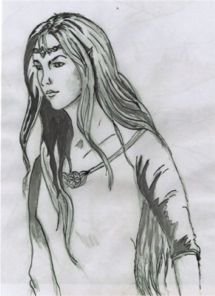

Nerdanel's Story

Silmarillion based fanfiction.

My Photo
Name:
Location: United Kingdom

I am a history teacher taking a year out to pursue other interests and courses of post-graduate study. This blog contains my first attempts at writing fanfiction, or any form of fiction. It is very much a working document and subject to many re-edits.What I write is based on the wonderful works of J.R.R. Tolkien, (edited by C. Tolkien), and is purely for my own pleasure and relaxation. I certainly do not do this for profit of any kind. Some chapters are at present submited to ff.net and 'The Council of Elrond' sites, although Nerdanel's Story is undergoing a lot of re-writing at the moment. There are many ideas and some names that I have taken from the 'History of Middle-Earth' series, so some terminology may be unknown to those who have just read 'The Silmarillion'. I am not an expert on Professor Tolkien, Quenya, or on writing, so I will probably make lots of mistakes! But as I mentioned, I am doing this for fun, and happy to learn as I go from those whose writings and thoughtfulness I admire. The avatar is one of my own sketches of Nerdanel.

Saturday, April 28, 2007


Flame


I have recently re-edited the original 'Flame' story - no real change, just some tweaking with points, and some hints dropped at further developments. Busy day again today - which means I will get behind with editing! But a happy family are very important to me!

Watch out! The doll is back!


Flame.


(Disclaimer: All characters and the world they inhabit are the wonderful creations of JRR Tolkien, or are inspired by reading his works. All mistakes are mine. All references are from The Silmarillion or HoME 1, 10, 11 and 12. I make no money from this.)


“Long he (Fëanor) fought on, and undismayed, though he was wrapped in fire and wounded with many wounds; ---”

(‘Of the Return of the Noldor The Silmarillion. J.R.R. Tolkien. Ed C. Tolkien.)


The house or Sarmo Urundil. Seventh Age.


Is it now that I am dreaming? Is all the grief of the many ages past but some trick of my mind? Will I awake from what has seemed a long, lonely widowhood to find him still by my side?

I feel the touch of his fëa against mine; an exquisitely gentle touch, yet one that ever grows in demand of me, filling all of my senses with a fierce and joyful longing. I feel the touch of his hands, his strong, dexterous fingers - and his breath, warm against my skin. And I am enfolded in his arms - in the fire and the flame of his being ….

But now darkness has come; darkness has fallen. Another flame there is, enfolding him in death.


- - - - -


A dream of a vision it is that haunts me. For over an age have I rarely dreamt thus of Fëanáro; though dream of him - of them - I do. But that dream of events in the Hither Lands was with me again this last night. Since I have begun to record my memories of the early days it is an experience that occurs more frequently. Almost do I believe Moringotho wills me to have remembrance of that event to taunt me into despair, that I put down my pen and make no case for my lord of old. But I am an inconsequential opponent to a Vala. The Enemy would be concerned not one jot with my attempt to reclaim some of my lord’s honour through my writings. And Moringotho; he is bound behind the Door of Night, is he not?

Nay - the dream is of my own heart and mind. From my own sense of guilt and loss does it arise.

To my shame it is, that I was not with my husband in hröa when he died. Mayhap he would not have perished thus had I but striven longer to change his mind-mood? But he asked the impossible of me. At that time, impossible had it been that I should desert Aulë to follow one who had become so fell and rebellious. And Fëanáro was angry, so very angry with me that I chose loyalty to a Vala over loyalty to him.

Think not that I am unaware of my husband’s many faults, of his cruel deeds. I hated, I abhorred the folly into which he was led; into which he led our sons and others. But with the passing of years has come the clearing of my sight. Since that incident upon the cliffs beyond Alqualondë– that faintest mind-touch of regret - much better have I come to understand why my lord followed the path he did. Much better do I know my own part in the downfall of the Noldor, for I was deceived as much as any. ‘Nerdanel the wise’, they used to say: nay, Nerdanel the fool, to discern not the ends to which Moringotho’s deceptions would lead.

I hear your thoughts, reader – that Fëanáro and I parted before he left Valinor. That he could not expect she who had estranged herself from him to accompany him into the east. But that is another memory to record, and at another time. Of the memory of his death do I now feel constrained to write.

Now this is the history and manner of my dream.

Though I never had the gift of insight into minds that Artanis possesses yet, inherited from my mother and from the art of close and careful observation, I had more insight into hearts than many. After the birth of Maitimo there were a few occasions when I saw events as from afar, as if I were using a palantir. But an action of my own thoughts it was, with no availing of my husband’s creations.

With Fëanáro I had a close bond indeed. Of one heart and mind were we in the early years of our marriage. And so many sons did he give me, so many of his children did I bear that, each time I was with child, each time I mediated his fëa to those yet unborn, our union become but stronger. Now as all do know, the union of fëar between most couples is strongest when they abide in the same place, though many have the ability to reach out to the other over some distance. So it was with us. When my lord rode out with our sons on journeys of exploration, those times that I went not with them, we could still communicate, each with the other. On occasion did we communicate thus for some very many days. When they all rode out to seek the borders of the Dark they were gone for half of a year! So long to be parted it seemed to me at that time.

‘I miss thee!’ I would oft call to him.

Arrow sharp would his thought return. ‘And I thee, beloved.’

I did not know then what missing him truly was.


- - - - -


Now it was nigh two years after the departure of the hosts of the Noldor from Tirion that the vision came upon me. Almost two years of darkness that we who remained endured in Aman. For the light of the Trees was no more, and no moon was there; neither had the bright sun risen. Only the stars of Varda, our torches and candles and those gems that blazed with blue and silver fire did we have that it seemed we were returned to the Hither Lands.

I had been dwelling and working again in my father’s house. Though Aulë came not amongst us for a space, and the Teleri – understandably - shunned us, yet was there ever much to do, to try to repair some little of the harm done to all. With my father in his forge had I been when the warning came upon me. I had gasped and stumbled, that Tulcon had cried out for me to take care. My father had caught hold of me, taking me away from possible danger to sit in his workroom. No deep vision it was that I experienced, save a momentary sight of fire over the sea.

I called for my mother, for she who first had such intuition of flames and sea in relation to Fëanáro.

“What does it mean? What is happening to them?” I had asked; fearful that this would be another battle, another kinslaying. But no clearer were any of us as to what was taking place than before. Since the destruction of the Trees no message had gone forth to the Hither Lands. Neither had any message returned, save what we knew of sorrow from those Noldor who had accompanied the wise Arafinwë back to Eldamar.

My mother had knelt by my feet, holding fast to both my hands. My father, Tulcon and Tuon hovered close by with concern. Then it came to me, the voice I had longed, and yet not longed to hear.

‘Ai; Nerdanel!’

For the briefest of moments I was acutely aware of Fëanáro’s thoughts, sensing his great dismay. It came as a shock to me as I had experienced no directed thought from him since our last parting words. For that instant I felt the touch of his fëa again, reaching out to me in pain of loss. Then his anger flared, and his consuming hatred for Moringotho - his hate, it blocked out any further touch between us.

Thus I knew that one of our sons was dead in that fire, though I knew not then which one.

For a time my anger flare against my husband most strongly, (though only with the return of the exiles was I to know his part in that son’s death), and so was the bond between us doubly blocked. Such anguish was that for me, not to know clearly what had befallen.

Again did it happen, many days later, very many days. I was alone in my room, about to take rest, when the sharp arrow of his directed thought became fixed in my mind. The thought was wild, fey indeed, as he cried to me: ‘Vengeance now shall I have!’ But that was all. It was as if he wanted me to know he had been right to defy the Valar; that he would bring down Moringotho himself by the might of his wrath.

I sat up upon my bed, filled not with any awareness that Fëanáro was justified – not with any exaltation - but with a sense of dread. Something was very wrong!

Then it was that the vision unfolded, as a large map upon a tabletop. In the light of the crystal lamps the room about me was a silver-touched glow, but what lay before me was a half-wrought camp, movement in darkness, the flash of helms, swords under starlight and the red of blood. I could see very many foul and terrible creatures - to my eyes, deformed corruptions of life - which I took to be the ‘Orcs’ spoken of by those who had made the great march. Engaging them in battle with much will was the host of our House only. Of the blue and silver banners of Nolofinwë and his followers was there no sight. Outnumbered greatly were our people, yet they fought on with the fire of Aman burning in their eyes, their long swords slashing through their foe as easily as through air.

A confusion of colours and sounds, then a blurring of the vision came about, that I believed Fëanáro and our sons to be well occupied in the giving forth of battle. Nothing further did I perceive for some hours. I lay again upon my bed, wishing to ponder what had been shown me.

Failië came to call me for the early meal, but so held was I to what I knew perchanced with my family, that I asked that but water be brought me. She knew - my parents knew not to disturb me when I was in such a mood of reflection.

Many hours must have passed, mayhap even a day or two? I left not my room, but would have called in prayer upon the Valar for aid if I could. Then again was the vision upon me that I saw swift riders under cold stars - Fëanáro and six others, ahead of the main force. Riding fearlessly they were, in pursuit of a remnant of Orcs fleeing back to their dread master. Fëanáro’s sword was held aloft, and I heard him laughing - urging the others onwards so as to come upon Moringotho the sooner. That he intended to seek personal combat with the Vala who had slain his father I had no doubt. But though in my room in Aman, I was granted a greater field of vision than he in the Hither Lands. I saw the dreadful creatures of shadow and flame issue forth from the dark mountains. Seven of them there were. The host of fleeing Orcs turned at bay at that sight, preparing to make a stand. Orcs and Valaraukar there were, setting a trap.

“Fëanáro! Turn back! They lie in wait for thee! It is ensnarement that they plan!” I called aloud, rising to my feet; though my voice could carry no further than the confines of the room. Neither could he have heard me in his thoughts then, so clouded was his reason, so consumed was he by his battle fury.

The vision shimmered before my eyes, and I knew that, again, some time had passed in that land over the sea. I knew also that he had not turned back.

Sinking slowly to my knees upon the floor, my remaining anger against him faded away in that moment as mist in the light. No matter what he had done to cause grief, yet did I wish him many miles from that place – did I wish him not to be slain and in such a manner!

A circle of flame lit my view. The seven servants of Moringotho encompassed him as he fought on, undaunted by them. By his feet lay the crushed and burnt bodies of those loyal friends of his: of Tulcavaryar, Alcarin and four others. But Fëanáro could not be brought down. He was swift and agile and strong; his opponents could not match him for all their might. I saw with hope and near wonder that he moved around the fallen bodies of many of the Orcs; that he had wounded some of the Valaraukar, that two were lame, moving but stiffly in gait, and another bore the marks of Urrussë upon it’s form. But the moment when I thought he might yet prevail, even against such odds, was soon to pass. I beheld that, valiant though he fought, he bore many wounds himself, and burns from their swords and whips of flame.

It was as if I were watching him competing against others of the Noldor in the arena in Tirion. Five or six or more would he oft try himself against, and harder still did he train with our sons in those later days of swords and banners and lies. But those seven were not Eldar; they were Valaraukar - corrupted Maiar - demons of terror.

'He is nigh exhausted,’ thought I, with cold realisation that he could not prevail alone. As if in answer to my thought, Fëanáro stumbled - just a little - but it was enough. His shield was torn from his hand as he was wrapped in their flames once more. He did not cry out in pain or fear, even then.

In my room, sitting motionless upon the floor, silent tears were upon my face. I could not watch, could not know the unthinkable, that he was defeated. Was this to be the result of my failure to ‘care well’ for Míriel’s gift? Was it to be the end of his dreams, the outcome of his eloquent and impassioned speech upon the summit of Túna?

“Fair shall the end be, though long and hard shall be the road!” he had said.

Fair? Nay, it was not to be so for him!

I reached out in thought to our sons, though I had never any bond with them beyond usual for mother and child. While they had been young had I oft sensed their needs, but not once they reached maturity. Even less than I could reach Fëanáro could I reach any of them. But try I must.

‘Maitimo, be quick! Thy father is failing, even he. Makalaurë, Tyelkormo - he is near the end of his endurance’. As I called, I knew they heard me not and in part I was glad. I had no wish for them also to be wrapped in the flames. Yet I knew that, without our sons, Fëanáro was lost.

On the farthest edge of vision the tall, bright figure of Maitimo was fighting his way through those Orcs still standing, trading blow for blow with those hideous creatures. A fell warrior was he become, our firstborn, as he wrecked determined havoc upon all who stood in his way. With that son were many of our people, but none could breech the circle of flames to give aid to their king.

‘Fëanáro, they come - soon will they be with thee!’ I called in thought.

Alas, it was not to be. The ground rumbled, as out of the shadows loomed a shape greater and more terrible than the others. In his hand was a monstrous black axe. The very Lord of Valaraukar was being sent out against my husband. In full strength, aye, I believe Fëanáro could have defeated him - but not after fighting so many, so hard, and for so long.

Yet did my lord make to face that creature as an equal, and more! That most fell of Balrogs swung down his axe in an attempt to cleave Fëanáro asunder. Again was my husband swift of foot and, evading the blow, hewed mightily at the body of the Valarauko in return. They circled each other; though still in the midst of the other servants of Moringotho were they. Twice more they exchanged blows that Fëanáro, without a shield, was wounded again.

With pounding heart I watched as another of those creatures let fly its whip, wrenching Urrussë from Fëanáro’s grasp. Defenceless now was he, yet he tried to evade them, tried to take up a sword from the flaming hand of one of his enemies. The Lord of Balrogs struck at him again, with a blow to his chest that, while not cleaving him, brought him gasping to his knees. A clawed foot was placed upon he who had long been my love – my life, driving him into the dust of the ground. Numbly the realisation dawned on me that the Valaraukar intended not to kill him quickly.

‘Maitimo, be swift!’ My desperate thoughts winged forth to my eldest son. If I could reach any of my children – it would be him!

Those creatures of shadow and flame wrapped their whips of fire around Fëanáro’s body, dragging him behind them, moving fast for creatures so large, in a game like a thoughtless child might play with a toy. Dragged across the roughened ground and rocks was he until, for one moment, he was caught between two larger stones and would not easily be pulled free.

Finwion!’

With the love I had sought to bury within me I reached forth my fëa, seeking the slender thread of union that should still be between us. Although he could not have felt me in hröa, I fell upon him, throwing my arms around his neck as I covered his burnt and broken features with my tears. I wanted to wash away his hurt, as Nienna could, and make him whole. I wanted to bring him healing that he was again what he had once been.

Pain hazed eyes opened and he knew, aye, he knew that I was with him.

‘False wife and mother!’ he struggled to respond. ‘You who deserted me, keep now your tears. I need them not!’

The sharpness of his words caused me to recoil, that the tenuous link was broken. Never had I thought we who had once loved so well, would come to this.

Though he made to reject me, yet still was Fëanáro in my vision. And I would not leave him to perish alone. I would not leave him a third time. So I hovered close – as close as I could without adding to his anguish – that he knew I had not deserted him.

Then he reached slowly, determinedly to his neck, as if to touch something that was mayhap hung around it, under the hauberk. The Green Stone upon a chain it was, which he brought forth in his charred and blackened hand. Despite his harsh words, Laicasar, that was my wedding gift to him, was yet about his neck. There was a familiar tug upon my own fëa; one last bright flare of his commanding eyes as he seemed to search for me, his mood momentarily changed.

‘Nerdanel; shed not tears. Never did I leave thee, lady,’ his blood smeared fingers were upon the stone. ‘In memory art thou ever mine …’

He could not maintain his focus as the Valaraukar tugged his body helplessly from the rocks, setting him again in their midst, making to utterly crush his sensitive, creative hands. One wave of his agony I felt; then his thoughts were shielded from me.

I would have called unto the Valar, unto Eru himself in my anguish for my husband. Yet how was I any different to the wives and mothers of the Teleri? I believed that none would hearken to the plea of the wife of Fëanáro.

In silent helplessness I watched as the rest of the vision unfolded before me. Maitimo and Carnistir with a great host cut and hacked their way into that circle of flame. Ambarussa the elder approached his father’s still form from another direction. It seemed the Valaraukar retreated, though I wondered why? That they had dealt Fëanáro a mortal blow they must have known. Mayhap that was all their purpose at that time?

Our sons, they raised up their father between them, bearing him away, to an upward path to a mountain pass.

That he would soon die, both he and I knew - though with firmly spoken words of encouragement did Maitimo and then Curvo try to renew their father’s strength to live. A chill thought struck my heart. What if he were to be condemned to the Everlasting Darkness, as he had so made oath? What if Fëanáro would heed not the summons of Mandos at death? We still knew so little of death in Aman, though since the kinslaying did we know more than we had! That Mandos summoned the fëa of the slain, we knew well since the debate over the death of Míriel. But Fëanáro had defied Námo Mandos before. What would happen if he refused to return?

Our sons lay him down upon the ground, as gently as they might. And now they knew also what was to be.

With fading sight he looked to distant mountains, triple peaks that rose higher than any I had seen before the Pelóri had been raised. Then with pain bought breath he cursed them, and cursed also the name of Moringotho thrice.

“Treat not, neither parley with thy foe”, he instructed our sons. (If only Maitimo had taken that instruction to heart.)

About his neck was he still wearing the Green Stone. He signalled for Maitimo to take it from him.

“Keep this well. Avenge me and thy grandsire, and hold true to thy oath.”

With his final breath he again laid that accursed oath upon our sons. Why that? If only he had spoke otherwise! If only he had blessed them, or bid them pursue release from those terrible words of hatred. Yet the oath had been made freely before Manwë and Varda, and they had called upon Eru, each one in their madness. Such an oath was binding, reminder or no.

They bowed their heads, our sons. For now were they all there save for Ambarussa the younger. My suspicion that it had been he, it had been ‘Umbarto’ who had died earlier in the fire was confirmed.

Then the low-smouldering fire was out! Fëanáro died!

His spirit was so bright that his already burnt body was totally consumed as he sped forth.

‘Fëanáro - come thou home!’ I pleaded, as again I sent forth my own fëa, soaring upwards as a bird in flight.

I had thought to meet him above the clouds, that we might take wing together for a final time - that I might draw he who had turned his back upon Valinor, ‘home’. But there was no need. Freely did the spirit of Fëanáro hasten into the West.

The slightest of touches there was, of anger tinged with a dawning realisation of the depth of his loss, then no more. The Spirit of Fire had come to his journey’s end.

Much later it was that I wondered why I had not told him that I loved him - that I had forgiven him his ill deeds - that I partially understood! I should have told Fëanáro that I loved him.

Mayhap he already knew!


- - - - -


I must have lost consciousness. The next I knew was that I was lying upon my bed, my parents seated nearby.

“Rest, Nerdanel. We know what has happened.”

My father spoke in hushed tones, my mother looked most pained, understanding something of how I felt. Had she not held Fëanáro in great esteem until nigh the end?

I could not answer them. I could not find it in me to give forth words. No conversation had I then for anyone, or for very many a day.

“They found thee lying outside, under the apple tree.” my mother spoke in a broken voice “Tuon was looking for thee, to tell thee what he had seen in the sky.”

I did not remember walking into the orchard, but I doubted not that they had found me in that place where we had oft and passionately declared our love for each other, my lord and I.

“They saw a flame like unto a shooting star, burning brightly in the darkness as it headed from the east to the north-west shore of Valinor. No mere feature of the sky it was, Tuon informed us.” My father explained as gently as he could, knowing well what, or rather who, the speeding flame was.

My parents bowed their heads. That my father was furious with Fëanáro's deeds, with his disregard for Aulë, his misuse of power, of skill, and not the least, what he had led our people to do to the Teleri, was no secret. That my husband had taken all his grandsons from him and nigh broken my heart, my father could not forgive. Yet would he hold his peace. He would mourn the passing of one who had been intended for greatness.

Instinctively I reached out in fëa as I had always done when greatly troubled. But Fëanáro was not there. It was not as it had been in those days when I had called to him, but because of his mood, or because he was occupied with work he had chosen to answer me not. Neither was it as it had been those last years we had lived apart. Still, though no words had been exchanged, I had felt his presence. But Fëanáro was no longer there. With his death we were estranged indeed.

In silence I mourned my lord and our youngest son. I went about my work and duties with fixed purpose, and a determination to endure for my parents sake. But the gloom, and sense of immense grief would not depart me. A further two years it was before my heart had any lightness at all, before I was able to speak freely again with others. Despite the grievous woe he had caused us all, had Fëanáro ever been my bright flame. And at that time I greatly wished that I had died with him.


- - - - -


So now have I written of that which is a bitter memory to me. With the telling do I hope to lie to rest that particular dream and turn again to the task I have set myself. Mayhap, when the recording of my memories of the early days is complete, I will seek to join my family – to join him? It is said that the only thing that binds fëar in that place of Námo Mandos is great love! If that is so, as I believe, and he bears no grudge against me, has forgiven me even as I forgave him, then we will be united once more, my lord and I, that at last we shall bothknow of healing.


- - - - -


Time is in Years of the Trees.
Moringotho – Morgoth
Artanis - Galadriel
Valaraukar - Balrogs
Urrussë - ‘Flame blade’ (russë is the poetic word for blade – I think!.)
Maitimo - Maedhros
Tyelkormo - Celegorm
Carnistir – Caranthir
Finwion – Son of Finwë. A childhood name of Fëanor. I write Nerdanel using ‘Finwion’ on occasions.
Curvo - Curufin. I am using the shortened form of his father-name when Nerdanel speaks of him, as it says in HoME 12 that he alone of the sons preferred it to his mother-name.

‘Fair shall the end be,’ he cried, ‘though long and hard shall be the road! ..’ The Silmarillion. Of the Flight of the Noldor.

The Green Stone of Fëanor: This is mentioned in footnotes in HoME 11 ‘The War of the Jewels’. It implies that Tolkien was pondering the history of the Elessar, with it being given by Fëanor just before his death to Maedhros, who then gave it to Fingon. This does not agree with Tolkien’s later thoughts in ‘Unfinished Tales’.

Labels:

Tuesday, March 20, 2007


Flame Rekindled. Chapter Six.

At long last I am on roll with editing chapters of this story again. I am posting my writing on ff.net first at present - but this has now been on there for a few days, so on the blog it goes. :)

Apart from writing these stories - reading - looking after various folk - and trying to get on with writing 'properly', things seem to be settling down a little. About time to! And after the glorious summer we have had the last two weeks, it is now snowing! Just right for trying to catch up on line!

Picture is of the Lakeland Fells. It has the right sort of 'atmosphere' for this story, I think!


Flame Rekindled: Chapter Six


A/N I am so very sorry at the long delay in posting chapters of this story, and others. Hopefully I will be able to post more regularly now.

(Disclaimer: All is Tolkien’s except the interpretation and any mistakes. I make no money from this)

With many thanks to Ellie for Beta reading.


“… there is in the Halls of Waiting little mingling or communing of kind (of Quendi) with kind, or indeed of any one fëa with another. For the houseless fëa is solitary by nature, and turns only towards those with whom, maybe, it formed strong bonds of love in life.”

(The Later Quenta Silmarillion. Morgoth’s Ring. J.R.R. Tolkien. Ed C. Tolkien. P223)


Máhanaxar. Seventh Age. Recalling thoughts from the Halls of Awaiting.


Think not that, of a sudden I had great love for Nolofinwë – it was not so!
The recent image of those objects of my heart’s desire still burnt brightly in my thoughts, shining their hallowed light through the darkness of my captivity. Mine, I say! I knew the light was of the creations of Yavanna – but it was I, not she who had been foresighted enough to house it in a manner that the light be ever preserved. The greater light of the Trees was Yavanna’s – it was true. The lesser, but surviving light of the Jewels was mine alone!

And my Jewels had been made that they would survive until the End. Try as he might, Moringotho could break them not, nor destroy them. None could break them - none could unlock the Silmarils, not even Aulë. None save I could release that light – though in so attempting would my heart have broken, that I would have perished. For the light of the Silmarils contained more than the blended light of the Trees - it contained a portion of my fëa pored into the making, that I could never have made the like again.

So then I thought. So then I believed.

But though holy in themselves, the Great Jewels had a way of illuminating darker tendencies and desires where present. It was as if they gave cause for all to show of their true self, and no facade.

Thus it was that even as I accepted Nolofinwë in a manner I had never before considered, memories of my life poured out afresh, as a fast flowing torrent before me. Those memories were of the days of deceit; of acts of cruelty and anger; of the battle of wills with my brothers – and with the Valar who cozened my people. And I felt shame that I had behaved in some respects ignobly. Though at the time had I thought all my deeds necessary – I perceived that some few had been matters of my personal will alone, and for no great purpose other than to demean.

Much discomfort did that awareness bring me – I who considered myself the noblest of Finwë’s children. Then the half-truth of the reason the Valar brought the Eldar to Aman struck me anew, and as a diversion. Nothing had ever been said to my father, or to any of the ambassadors of the three kindred concerning the Aftercomers. No message did Oromë give that those who followed him were to be supplanted. Would the clans of the Eldar have left the land of their birth knowing that in so doing they handed their birthright to a younger, lesser race? I think not! No more would I have handed my birthright to Nolofinwë!

The secret that had become secret no longer – that the Secondborn would supplant the Firstborn, and defraud us of our inheritance from Eru Ilúvatar – was wilfully and ignobly withheld from us. Was it any wonder I could not endure such a thought, but planned to return the Noldor both to freedom and to the lordship that was ours by right?

That a second race, whose life span was but a moment in time, would be set to rule over the Hither Lands in their ignorance was beyond my understanding. I could not see the purpose of Eru in so doing, that I thought it a plan of the Valar alone. Those Great Ones either cared no longer for the whole of Arda, or more likely, believed that weaklings would be the more easily controlled by them. None among those Followers would there be like unto Fëanáro to give them of challenge.
Yet what did I truly know of the Second People, save that which Moringotho had purposed I should know? What did I know of my brother’s intent in those last days, save what Moringotho intended?

My mind was in turmoil that, ponder though I might, I could see no clear way forward. What was truth? When did it all begin - that opening of my mind to deception that I saw not the lies set before me? Nolofinwë had of certainty been proud and jealous – but in my chosen blindness to anything worthy concerning he and his brother, I had not seen his inherent sense of honour.

“Half-brother in blood, full brother in heart will I be,” had Nolofinwë said before Manwë upon Taniquetil. I wondered then, for the first time, what it had cost him to speak thus? That he who was acting king - who ever sought to better me, and yet could not - would stand down for my return, that it was the only way our father would take up again his kingship.

And in the memory of my vision of the Silmarils, the knowledge that Manwë had willed reconciliation between the two High Princes of the Noldor was no longer just the thought that he had wanted me to wear my Jewels that the Valar might take them from me. Mayhap had Manwë wanted the sons of Finwë reconciled for another purpose? That there might be healing in Aman; aye, even as she had said to me - but there was still something else; something else that should have been, but was not - because of me?

'I would speak with my brother!' I again addressed Mandos in thought, believing my belated acknowledgement of the truth I had chosen to ignore gave me some right to so speak.

Silence

I felt no sense of the presence of Mandos. Rather did it seem that I was in a large and empty cavern – that my thoughts almost gave echo – that I almost perceived a draft of air in that place of darkness. But I would have my answers from Nolofinwë, so I focused my will to call again upon the Vala.

'If Nolofinwë is in this place – even as I believe – I would speak with him of matters past that I know what was said to him of me.'

'The fëa is solitary of nature, as well thou dost understand, spirit of Fëanáro.' Mandos sounded his usual solemn self, but somewhat more distant - as if his words echoed through that same, large empty cavern.

'Say you that all spirits here are in solitude, with but thee ever for company? A miserable thing indeed then it is to be parted from one’s hröa!' I made to draw him to me, that I had his full attention.

'Thou speakest only of that which thy limited mind can yet comprehend, O Noldo! Though many are solitary for a time that they rest and heal, that they are purged of any guilt or wrongdoing on their part, still does great love binds fëar in this place, as in others. Though thou dost yet know of love, think thou to possess it in such capacity, or to have inspired it in any other?'

‘Limited mind!’ thought I with a sudden flash of temper! But also I thought that mayhap I was having effect upon the immovable Doomsman to so provoke him. 'Say thou that none here so love me, nor I them – that I know not the meaning of great love? Is that not what thou wouldst have me realise, O High One? That none do love me? Not my brother – that I can understand; though still would I speak with him! Not my youngest son – and that I unwittingly slew him! But my father, my mother love me, and I them! If love is the bond that unites in this place, why have I not spoken with either of them?”

The silence of Mandos gave no answer to my question. Yet I began to consider whether the Valar had truly forbidden me company, or whether there was any hint of truth to my jailer’s implication. Were there none who loved me enough to be with me - who I could draw to myself?

'My parents both love me!' I stated assuredly. 'Even if none other in this place feels such emotion - they love me well – and I them. None loved their father as much as I loved mine!'

I would not believe otherwise. I would not!

So I turned my thoughts to time spent with my father. I recalled a particular day when I was but a few years old, and he dismissing Silwë and others to give me extra lessons in the study of language, for I had exceeded all that Niecarindo could teach and would know more of that instant. So proud of me – of my interests had my father been. I remembered those times we spent together, seated in his study, or in the inner courtyard, by the fountain – while he spoke of his delight in the mastery and development of words – and I sought to likewise delight.

And again, I thought upon a time of walking in the hills in his company. Far from Tirion had we wandered, he and I, glorying in our strength and freedom – supposed freedom? But he was king of a growing people and took seriously his duties – he did not wander the hills with me as often as I wished. Would that he had never wandered the hills at all, and avoided that fateful day when he encountered the Lady Indis!
There were none like my father! None so valiant, so noble of appearance, so eager, so thoughtful – so kingly! None who had my love and admiration in such measure – and when my mother left us, I had loved him all the more.

But as I so considered, did I not recall wondering why my mother had chosen not to return to me – why she would not respond to my desperate call to her in the Gardens of Lórien? Had I not also wondered why my father had so soon insisted on remarriage if he loved me well? And thoughts from my early youth returned that I had caused the death of my mother, that I had not been enough for my father. Though he had me – he wanted more! He had wanted to bring many children into the bliss of Aman.

'It is no wrongdoing to want many children, as thou doest know of thine own experience. It is no slur on the worth of a firstborn child to want of a secondborn. Neither did Nelyafinwë act as if such was a slur upon him - though thou begat son after son! Thy firstborn; never did he feel the others were a sign he was not enough for thee – save when Curufinwë was born. Even then did he strive so that love and kinship overcame thy ill-shown favouritism, that for the most part, thy sons were as one.'

'Thou doest say I have failed as brother, son and as father? Be gone from me, you who know not what you judge when you look to those in hröa.'
So did Mandos leave my presence in the manner that I could detect him not at all. (Though I ever suspected he was watching me most closely). Departing words he spoke to me:

'He whom thou namest brother takes of much needed rest from the most foul manner of his death . So close was he to Melkor when he perished that his fëa could have been taken if intervention had not been made. Now he sits in the shadow of his thoughts, in the company of his firstborn son. For Findekáno was slain by the same spirit that slew thee! And Arakáno, who was earlier slain, watches over both.'

Arakáno slain? I had known not that was the case. That most impetuous of Nolofinwë’s sons – slain! And Findekáno? He who had rescued Nelyafinwë from his torment, who had oft been in the company of my sons in the earlier days that she had said it seemed we had eight sons at times. I had not overly approved of that friendship between cousins, but they were no children, and were careful not to be in my presence overmuch. Then came the time of strife – and Findekáno came to our house no more.

‘My brother has two of his sons to keep him of company in this place,’ thought I. ‘No surprise it is that I may not speak with him. What need has he of me, when he has those he loved – and who loved him - at close hand?’
So again did I endure in my solitude, though I pondered that so many of the Princes of the Noldor were now slain, and that it seemed those of my blood alone had strength to endure. I pondered also on what could possibly continue to keep me from my father – from my mother.

Never would I believe either had not loved me. Yet I felt a strange sense of emptiness as I continued to pursue my chain of thought – as if in some way the love I thought to recall had but little substance.

That my time spent in the company of Mandos had in some manner blunted my perceptions was my first concern. That place, it was not the one we Quendi were meant for – not the place Eru would wish us to exist for the lifetime of Arda. I knew that! My mother would have realised that in time - and returned to us, had my father not ended their marriage.

I had not been enough for him! Though I tried to be one in whom he could take pride – one of whom he could say: ‘My child is the most excellent in skill and in knowledge, and in wisdom and nobility, my father had wanted more sons – had wanted daughters. Surely he did not think to have another child as mighty as I – none other could compare with me! Of certainty Nolofinwë was not learned enough to offer serious competition.

But he tried!

As he had grown to maturity he pitted himself against me many times, in many differing situations – knowing always he would fail. Had it always been thus with him? That he knew he would fail against me – that he knew he would fail against Moringotho. But ever he tried! As I had realised the hosts of the Noldor could not overthrow Moringotho, yet had sat not idle in grief but given of pursuit, so had he ever given of pursuit of me!

Again I realised a grudging admiration that I had hitherto not realised. That my brother never gave up trying to win our father’s love from me. Or had it been thus? That in the memory of my Jewels I saw of a sudden that mayhap he had not wanted to be loved greater than I - but as well as I?

My life – it should have been different! I should have been wiser! I should not have so despised Nolofinwë that I lost his love and his loyalty.

As I thought again on my brother’s valiant, last battle - of Moringotho crushing him underfoot - my sight was drawn to those that were of my creating. And it seemed, to my interest, that the light was accompanied then by song. Not the deep, rich singing of Kanafinwë, but something both lighter and darker. Like unto rain falling into deep pools - beautiful, powerful and profound – the sublime voice rose in a form of incantation, then of a sudden was ended. In my mind I saw the Silmarils rise of their own accord from the crown of iron atop Moringotho’s head, - for he was stilled, as if entranced by the song - and move towards my outstretched hands until their light totally engulfed me, obliterated all else in thought or reality. My heart rose in joyful anticipation of their possession - then I was in another place.

"Hail; king and father!"

I turned abruptly to the sound of the words – aware that the vision of the Silmarils was gone, that I was seemingly clad for battle in hauberk and armour and thick cloak of red. It was snowing, and there was much snow upon the ground that the hoof prints of many horses could be made out.

Turkafinwë it was who had given call, and he riding past the high steps upon which I stood. Mounted on his black horse was he, with Huan and a pack of lesser hounds running at his side.

He bowed his fair head, giving a salute of acknowledgement to me. I raised my hand in return to him, and to Curufinwë and to Morifinwë, who with a small host of lightly armoured riders were following in his wake towards high, open gates.
Most clear it was that they rode to battle – to confrontation on that cold, crisp day. And I watched them depart into the wilderness until I could no longer make out their forms.

Then with a swirl of snowstorm white, the scene before me had changed. Nolofinwë was there – upon his favourite horse, garbed for battle with his bright sword in hand. Hale and well did he appear, as a leader of a mighty host. I saw that at his right hand rode Arafinwë, while at his left was his second son, Turukáno – both similarly attired. Then there was the sound of horns – a summoning to form ranks. My field of vision widened, as if I had retreated some distance that I saw those three were foremost of a host of hundreds of Noldor cavalry, forming ranks before the city of Tirion. They appeared to be preparing to ride to the attack, and in deep snow.

‘What is this?’ I wondered with some perplexity. ‘Always have I seen memories of my own, or sight of what transpires in the Hither Lands. Yet this is neither! Has Moringotho returned to Aman? Is Nolofinwë already returned? Is he who I thought to be resident in the same halls as I, to be early released?’

Again my perspective changed that I was standing in the Ring of Doom, looking to the east. The sound of ongoing mêlées rent the air - the clash of metal upon metal, a whirling sound that I had no knowledge of, and a heavy drumming. Upon the snow was much red blood – very much blood - and tangled, twisted bodies that seemed charred and darkened. I looked across the plains to behold Tirion aflame against a darkened sky in which no stars shone. And I grew cold, that I knew it a vision given me of what was yet to come.

‘There is no hope’ thought I as a certainty. ‘There is no hope for the Eldar, or for Aman!’

“Always is there hope - whatever comes to pass, Finwion!”

The voice had not the power of the earlier song, but it was as an unexpectedly tender caress. A female voice it was; one that I knew well.

“Nerdanel!”

But she gave me no reply.

Still I felt chill, as with the biting cold of the vision of traversing the Helecaraxë. Snowflakes were falling again, obscuring my surroundings – crystal individuality, white and shimmering landing on my hands, on my hair and shoulders.
Then of a sudden there was the warmth of a cup – a ‘farewell’ cup, finely crafted and bejewelled with rubies – being passed to me by a lady of some high status. Garbed and hooded in heavy cloak of grey was she.

I was struck by the sense of immense sorrow that flowed from her, that for an instant I thought it was Nienna herself, the Lady of Pity and Mourning come to offer the ‘cursed one’ her comfort. But it was in truth one I knew far better than Nienna. As our fingers touched around that cup she passed to me, I knew with the sensation of a lurching heart, that it was my wife.

“Nerdanel! Say this is but dream – that thou art not truly in this place?”
Oh I wanted her with me again with a sense of growing warmth and longing, as she had been before she could see only wrong in me. I wanted not to be alone – I wanted the great love of which Mandos spoke. But I wanted her not to have perished! I could not have both – mayhap I could not have either?

The faintest of smiles was upon her lips, as if she understood my dilemma. “I await thy return from this battle-to-be, my lord and my love. (Were those words not a most welcome draught – for after the manner of our parting I had thought never again to hear her speak fair to me!) But think not that I wait in idleness, neither that the nissi of thy house have no battles of their own to fight.”

“Battles, lady?”

I felt slight concern at her words that she gave me of warning. So did I will to touch her face with my fingertips, as I once oft had, and to show I paid close heed. And I felt the softness of her skin, a sensation that overwhelmed me. No dream – no vision – it was! She gasped with surprise, looking up to me, eyes widening in some confusion of her own. Then I was alone and in darkness.

But I felt different! I felt almost – alive?

I, who had called down the never-ending darkness to be my doom – I felt almost alive!

'We will continue, Fëanáro, son of Finwë'

Did I not expect the attention of Námo Mandos as soon as I had inadvertently thought upon she who had been my wife? Did not such thoughts always bring of his attention?

'So; thou hast returned to thy taunting, jail master! And with what shall we continue, I ask of thee – my memories of Indis, mayhap? Thou thinkest I will comply more eagerly with thy wishes now that I perceive Nolofinwë to be admired in the manner of his death - a true son of my father? But for what reason should I continue to play thy game?'

Mandos’ answer was immediate, and in a tone neither compassionate, nor haughty.
'For knowledge of the vision which now perplexes thee, most learned of the Noldor – and for the reason that, while Nelyafinwë yet lives, and Kanafinwë, and Pityafinwë - yet are thy other three sons slain through their vain and cruel pursuit of their oath!'


- - - - - -


Moringotho – Morgoth
Nolofinwë – Fingolfin
Nelyafinwë - Maedhros
Findekáno - Fingon
Arakáno – Argon (Perished in the battle of Lammoth.)
Turkafinwë – Celegorm
Curufinwë – Curufin
Morifinwë – Carnistir
Arafinwë – Finarfin
Turukáno - Turgon

Labels:

Tuesday, November 28, 2006


Flame Rekindled:Chapter Five.


At the request of Eru_Melin, here is another of my doll pictures! :) I have a camera that is hopeless at close ups, so I apologise for the quality. Maybe I will get a better camera for Christmas?

Today, I am posting chapter five of 'Flame Rekindled'. I have not done as much work on this story of late as I would have liked. I need to get another couple of chapters of 'Nerdanel's Story' on here next, then I will finish tweaking with chapter six of this story. Then I really must finish writing up Maglor's Song! So much to do - so little time - I need to read and study more too! Yay! *Looks bemused!*

So this is 'the' doll sitting on The Silmarillion and a pile of HoME books!!! ;)He is with a companion!


Flame Rekindled. Chapter Five


“Fëanor was the mightiest in skill of word and of hand, more learned than his brothers; his spirit burned as a flame. Fingolfin was the strongest, the most steadfast, and the most valiant.”


(‘Of Eldamar and the Princes of the Eldalië The Silmarillion J. R. R. Tolkien. Ed C. Tolkien. HarperCollins. p60)


“For Fëanor was made the mightiest in all parts of body and mind, in valour in endurance, in beauty, in understanding, in skill, in strength and subtlety alike, of all the Children of Ilúvatar, and a bright flame was in him.”

(Of the Sun and Moon. The Silmarillion J.R.R. Tolkien. Ed C. Tolkien. P 108)


Máhanaxar. Recalling thoughts from the Halls of Awaiting.


So it was that Nolofinwë had the victory! And did he not mean to parade it before me, to humiliate me before our father and our people?

Of my half-brother had I been contemplating, even as Mandos had instructed me, though of my own will rather than to comply with his. No purpose of gain would it serve me save this - I would learn to master the situation of my captivity. I would learn to ponder upon those memories that strengthened me or brought me of joy or of comfort. To my own thoughts only could I turn in order to make sense of the inevitability of my continued existence, but had I not ever been self-driven, so was this as another challenge unto me.

Instruct me as you see fit, Námo Mandos, and I will but turn it to my own ends. Nelyafinwë is free, it is true, but the oath-breaking son of Indis is king in his stead. My firstborn gave away the birthright of my House as a thanks offering, as payment for his rescue. What interest do you think I now have in aught that befalls the Hither Lands; save you tell me my sons have reclaimed that which is lost unto them? Save you tell me the Great Jewels are taken back from the Enemy? Only a matter of time will it be before one or more of the seven - one of the six had I thought in that instant, and with much pain at the knowledge of what I had done to Telufinwë - seek of opportunity to reclaim our stolen treasures. Though I understand that in no manner may the power of the Noldor overthrow Moringotho, yet may my sons do him great and dreadful harm that he knows of the depths of anguish and suffering; may they take back from him of the unsullied light he stole from me.

And I will bide of my time as I seek to grow in strength of thought, if time it is in which I exist. Yet are not these Halls of Awaiting within the Realm of Arda? Are not the Quendi of Arda? Thus it is that I realize myself to be within the time I have ever known, though my perceptions of the passing of such may be altered. So will I seek to gain what I can from memories while I am unlawfully held prisoner here: though mayhap not in the manner the Valar require of me.


Now had I been recalling a particular occasion in the year of 1233. My father had ordained three days of festivities in which there had been the usual feasting and entertainments of music, dance and tale; and competitions there had been amongst our athletes. I would have won in all events had I so desired to enter the contests, but it was not of my nature to make show of my prowess for other’s entertainment. Was I not the prince, the firstborn of the king? Let others entertain me, had I thought. No grievance did I have against such sport, and indeed, participated regularly in training and competition in the privacy of my house or at times in the arena with those lords who were amongst my closer companions. And had I, at that time, done something I did but rarely; I had changed my decided course at Ecthelion’s request, for the sake of my father’s honour, and participated in the javelin and the race in the arena. Was that not more than enough I deemed; for if I participated further would the sports become no true competition. Did not all know what the outcome would be? None there were as swift, as strong or as skilled as I, and let any who are foolish enough to question my assertion look to the records in Aman.

But that half-brother of mine, that usurper of my father’s time and affection, greatly did he love to hear the praise of the crowds ringing in his ears. At that celebration was he to do all in his power to win such acclaim. Not that he entered the events I had. Nor would he have. He wished to win!

Nolofinwë had participated in the long race: that which required of endurance rather than of speed, and the path of which led down to the coast nigh as far as Alqualondë before returning to the city. Many an athlete completed the course to fall at that last test, at the crystal stairs that led up the side of the hill of Túna to the great gates, or at the further two flights of stairs that led to the arena. He was not one of them; he finished first!

My half-brother participated on the second day in the archery contest, in which he came third, (never was archery his strongest point), in the early bouts of the quarterstaff, and in the tests of skill in riding, which again he won. Then on that third day had he ridden in the races that were five circuits of the arena. Had he not been first in that event, though Alcarin pushed him close, (and Kanafinwë the Swift closer still in years to follow!) So it was as I had expected it to be, and though far from happy was I not overly perturbed. I knew he was strong, I knew he was steadfast in all he undertook to achieve. Was his sire not also mine? But then had Nolofinwë ridden proudly back and forth before the crowds, waving gestures of acknowledgement of their support, and turned his beloved horse to face the dais whereupon our father, she who was his mother, and Anairë, who was then his betrothed, sat.

“My king and father; I do dedicate all honour of the events I have won to thee. For it is thy example in excellence that I have but followed.”

And my father had smiled upon him. King Finwë had praised of his second son before all!

Well said did he consider his words to be, to win more honour for the king than I. Had I not made every effort to contain my anger at that display. But it was a slight intended to show forth his challenge to me, had I thought. So be it! Still were there the finals of the quarterstaff to take place, and that event between my half-brother and the Lord Fionu. That lord, who sought ever to serve his prince, would willingly concede his place in the contest to me. I would show Nolofinwë the calibre of the one he thought to challenge, had I decided in that moment. I would bring him to lie in the dust at my feet, and most swiftly.

We were seated upon a second dais to the right of my father; my family and I. Behind Nolofinwë’s field of vision were we that he would not see me move to speak with Fionu nor enter the arena until challenge was given. None there were who could nay say me the right of contest, neither could Nolofinwë refuse challenge least he appeared craven in front of all. So I made to rise from my chair and in that same instant her hand was light upon my arm.

“Wilt thou not stay, Finwion?”

Her use of that most intimate of names always caught my attention, for so she had intended. Softly spoken were her words, her gentleness a covering for her own strength of will. Though her eyes were upon my half-brother’s performance, in fëa was her attention solely given over to me. So was her plea to me - her counsel - of touch and of word and of spirit. Not alone were we that she would use just of speech, for she was ever careful of what she said before our sons.

I had looked again to the wide arena, to my half-brother riding to and fro upon that white horse of his, (did he not insist upon a white horse of his own once he was old enough to realise Tyelperocco came to my summons alone?), and my anger at his presumptuous manner burnt strong. But I had noted her plea! Always did I listen to my wife, though not always take of her advice. She had continued to address me in fëa without waiting upon my reply, as the babe, Kanafinwë, though smiling happily at her became restless upon her lap.

‘What valour would there be in thy giving of challenge to Nolofinwë, in showing that thou canst overcome him as most assuredly thou would, my lord?’

The hand she had placed upon my arm as a gesture of comfort was reluctantly withdrawn to tend further to our son. She had made of soothing sounds to him that his face brightened further, that he repeated back the sounds to her with delight. But I felt the wave of her clarity of thought reaching out to me as a promised and much desired embrace of restraint.

“Wilt thou not stay with us, Finwion?” she asked again. “For thou to step into the arena, onto the field of contest would cause some, who are less wise, to think that thou didst view Nolofinwë truly as a challenge to thy own strength and skill, which is of course an absurdity. Give not fuel to those few who would so think, I beseech thee, beloved; for to let thy half-brother have his day shows only how noble of spirit thou art, how much esteemed by thy sire and in no wise jealous.”

I heard her request, the sense in her words! Her influence had given me cause to halt momentarily, for always in our youth did I desire her caress of enlightenment as much as her caress of hand. And in that moment had I also become aware of Nelyafinwë, seated to my right, and he shifting position as though to rise and stand at my side if to go forth was my intent. But it was Káno for whom he stood. For in that instant had Kanafinwë climbed down from his mother’s nurturing and with the laughing utterance of two of his few words, of “Aiya, Nelyo!” had he made swiftly round the back of the chairs for his brother’s company on most unsteady legs.

Only the day before had he first walked unaided. So did the parent in both of us watch of that instant his progress. Thus were we both to see our inherently graceful son stumbling over his own tiny feet in his great hurry, to be caught up, just in time, in the arms of his watchful elder brother.

An event of little significance it was, for though quick to master their hröa, none of our sons, nay not even I, had managed it in a day. But it was a strange memory that stayed with me in life, I realised. It was one that still resounded in the place of my doom: Kanafinwë's determination to run before he could walk; his elder brother’s care for him, and she looking to me with that small, secret smile that spoke more of her understanding of me than very many words.

‘Why it would be like envying Kanafinwë’s first steps, and he but a babe, when thou art indeed a mighty prince,’ she had added in thought, with a touch of humour.

I had felt my rage caught up in the shimmering net of love and of wisdom she had cast over me. Though she had nigh over made her point, how I had loved her for her stubborn perseverance; that she would so often say of the right words to give me room to ponder, to reflect upon my own words and deeds that they be not rash. And of course she had been right! Though Nolofinwë’s action had undoubtedly been intended as a show of his maturing strength, yet had I sought to demonstrate my superiority in that event would my father have been less than impressed with me. I would not react to my half-brother’s baiting in a matter so trivial, for so to do would belittle my dignity.

“It is even as you say, lady wife!” Giving a silent acknowledgement in fëa, I had lightly touched her cheek with my fingertips and taken again of my seat.


*****


Do you not observe, Námo Mandos? See how I do consider the one you continually instruct me to! Of Nolofinwë do I think, yet will I have a measure of control, of mastery of that which I will ponder, and not just for your entertainment.

Silence.

No answer was forthcoming from my jailer. Did he even pay heed to me any longer, I wondered? But no matter! With his presence or without it was I alone.


*****


So had I returned to my forging of memories. I would weave a rich tapestry, as had my mother while she lived, and that of all that held meaning for me. And if, mayhap, anything should occur which gave me any leverage against Mandos, would I not have used it? The Valar would never restore me until Eru commanded of them, for they hated and feared me. So, disadvantaged, would I be held in that place from which none, not even Moringotho, could escape. But I was not Moringotho. I would learn to do more than endure.

Again was I in thought of the third day of that celebration, though nigh the end and at the waning of Laurelin it was. I had not initially returned to the house with her and our sons, but spent some time in the company of Fionu (who was by then nursing bruises from the final event), and the Lord Tulcavaryar. Though I knew the wisdom of remaining silent regarding my half-brother, yet were my thoughts still restless that matters were not as I believed they should be. Late indeed did I return, and that after Kanafinwë was abed and much of the household partaking of rest from the excitement of the last days. Nelyafinwë I spoke with but briefly in the scriptorium. Books and scrolls had my eldest son spread over the desk in his pursuit of information on Tulkas. Much taken was Nelyafinwë with any trials of strength or strategy.

But a feeling of heaviness of fëa was come upon me at that time that I could not be free of, neither would I impose it upon my son nor any other. As oft in such moods had I sought solitude, though not in my workrooms or in crafting on that particular occasion. It was to the bathing pool in the south tower that I turned, without even calling for Maneharyamo to attend me, to bring of oils and linen towels and fresh clothing. I had entered the tall-pillared room, crossed the mosaic-tiled floor with its portrayal of the Maiar of Ulmo, discarded my robes and stepped into the warm water.

So good had it felt to take of rest. So good had it felt to have all weariness of hröa and of fëa dissolved by the heated and scented waters of the pool, and to drift for that time in thought. Yet was I not to be alone for long! But a few moments it was before I heard the sound of footsteps, of silken garments falling upon the tiles, of another slipping into the water at the further end of the pool and swimming to me. No need had I to open my eyes to know it was she, but I opened them nonetheless. She had made to swim alongside me, to kiss lightly of my cheek in greeting, but I drew her into a close embrace: my beloved, my wife, she who understood me better than any.

“I thought I might find thee here, Finwion,” she had said with a smile of pleasure that I was not in as bad a mood as she had anticipated. “So have I dismissed Maneharyamo for the time being. If it is agreeable to thee, will I give of my assistance in his stead?”

Looking up to the side of the bath, I saw she had brought with her all that was necessary; all I would normally have required to be refreshed. In truth, would I rather have the ministering of my lady’s hands to such a task than those of a servant! But still was my mind not at rest.

“Nolofinwë would claim the hearts of the Noldor for himself. He plays to the crowd for their praise, and for my father’s.”

“Shush, beloved!” She placed an elegant finger upon my lips, and made a mock frown. “Nolofinwë does but seek to copy of the example of his father and his half brother, that they are honoured by the people. See thou not how he does admire and emulate thee when he can? He would seek to follow thee in many things, not just in the sports, for he perceives in thee much of worth; much that Finwë honours. He does not intend to give thee of challenge.”

“Mayhap thou art right! But cunning is he that he seeks to replace me ever in ….”

“Shush, my dear lord! It is for thee to rest thy thoughts for awhile,” said she with some firmness. I did not finish my argument. She silenced me by the touch of her lips upon mine. Most persuasive could she be.


‘Again doest thou indulge of the comfort of that gentle lady whom thou didst drive from thee! Not a thought hast thou given of late to the grief thou didst cause her. Not a further thought hast thou given to the valiant deed of Findekáno by which thy eldest son was freed! No way forward is there for thee if thou wilt not pay heed to my guidance. I would have thee consider the results of thy rebellion, spirit of Fëanáro. Know thou that very many of the Noldor, that two of the sons of Arafinwë are slain.’ The sombre presence of Mandos drew me from that most promising of contemplations.

‘What of my sons?’ I replied of an instant, for did I not fear to hear the worst? That his statement would be followed by ‘And thy sons also are slain!’ But nay, thought I. My sons are strong; Nelyafinwë and Turkafinwë are strong and skilled captains.

“We will begin!”

Again came to me those hated words of the Doomsman; that he believed he had means to make bargain with me. But did it strike me then that Námo Mandos had a way of disrupting those moments when I recalled of my wife! Mayhap he was not the only one with a means of control over what was pondered and when? May it be that, should I wish of his presence I had but to think upon her, and he would attend me as if he were some servant? Most interesting to me was that thought, but it was swift and I meant to keep it close. So did I take up his demand to play again at the matching of wits.

‘Always are we beginning, but never do we progress, O Vala!’ I addressed Mandos, who gave forth of the impression that he loomed over me in some high vaulted cavern. ‘And I thought Nolofinwë was the one you wished me to think upon, not Arafinwë’s sons?’

“So he is!”

Many of the Noldor, including two of the sons of my younger half-brother had been slain. Mandos wished me to know of that! Had I not warned them all that long and hard would be the road? Had I not told them there would be need of their swords? Though no great love did I have for my half-brothers’ families, yet a flicker of sorrow crossed my thoughts that more descendents of Finwë were dead. And Aikanáro, he who had the light of flame in his eyes, had spent time in his youth with Turkafinwë and Curufinwë upon exploration. I had known him! Which two were dead I would not ask, that Mandos thought his words overly concerned me. Yet did I have memory of Aikanáro at my house in competition with Curvo; both laughing and calling the result of their unarmed contest in the training hall, ‘undecided’. I saw, as a passing flash of light, the silver-blue robed Angaráto dancing with his wife, Eldalotë, at Morifinwë's betrothal. And then I beheld Findaráto, again for an instant, at festival upon Taniquetil running eagerly to be at the side of the golden haired Vanya maid, Amárië. I saw him take up her hand most lovingly to his lips, and she smile radiantly in return.

She had not come with us, the one whom Findaráto loved. Another nís who remained in Aman, in loneliness and in sorrow was she. She, and Findekáno’s beloved, and Curufinwë’s wife, and Kanafinwë’s wife, and my wife! And Nolofinwë’s wife, Anairë, also, it must be said.

Why was it that our nissi would not come with us? Why would those of the House of Finwë not follow of their lords when so many others did without question? None of them were weak, none a feared. I had not understood it; save all had been cozened by the Valar.

Alone had I felt; beset by a ring of enemies. Though so many of my kin and my people were around me, though my newfound depth of hatred I had to nurture, yet had I felt so alone when she made her refusal to accompany us. Far worse than her refusal to come with me into exile from Tirion had that moment been! My father slain, my beloved Jewels stolen from my care, and instead of loyal support would she make my emptiness in that long night complete. Empty heart, empty arms, and empty bed!

So be it! And did she not learn to regret of her decision? But I had thought she would follow. That as she, in the fullness of time, had come to me at Formenos, so would she do again once in her right mind. Until that time we made away with the ships had I expected to behold her again, to have word brought that she had ridden in pursuit and begged to be with me. Ai! So had my mind at times pondered; but had my heart known I would see her not again after what transpired at Alqualondë ……I willed not to think on that; I willed not to think on her at that time with Mandos still so intent upon ‘beginning’.

Now I had been told that many of the Noldor had been slain, as well as Arafinwë’s sons. I pondered as to their whereabouts, for none did I discern to be with me in that place. Not since my death had I known the presence in reality of any save my keeper. As if the Halls of Awaiting had been created for I alone, did it seem. Or as if with Moringotho freed, I had been the one chosen to occupy his solitary prison.

‘Elda art thou; not Vala! Think not that thou couldst endure the torment Melkor endured before his release.’ Mandos made rebuke of me.

‘No? Is my fëa not from Eru, as is Moringotho’s, as is thine? Is it not recorded of Nienna, in the Namna Finwë Míriello, that while the Children are not mighty in life, yet are each of us in fëa as strong as you! Say you Doomsman that you could not endure what Moringotho did?’

No well-mannered way to gain information from Mandos was that, but I had thought to try of varied tactics. I would know of my sons, if they yet lived. I would know of any attempt made to avenge my father and I, and to reclaim of my Jewels. But not again would I beg or plead.

‘And Moringotho thou didst release, despite his deeds and false confessions of repentance. One law is there for the Eldar, and another for the Valar!’

Mandos was not one to react to my taunting, it seemed. Rightly was it said of him that he was immovable, or mayhap was I merely too trivial for him to belittle his dignity!

“Of Nolofinwë art thou to ponder.”

“Which particular aspect of Nolofinwë? You make order, but give me no direction. As if you believe me to know of all your thoughts and reasoning it is!” Most frustrating did I find the situation, yet I could think not how to manipulate Mandos to give forth of the information I desired.

I thought again of my half-brother as a child, and he in the hall of our father, looking to me at the dance.

“See thou not how he does admire and emulate thee when he can?” had that wife of mine said, when gathered in my arms. Neither lie nor deception would she have ever knowingly attempted to make. What was it she saw in Nolofinwë that was hidden from me? What was it she still saw in him those many years later that she spoke to me in his defence?

Again I saw him in memory, riding with all our family at the head of the host of the Noldor towards Valmar for the festival. He had endeavoured to speak with me on that occasion and I had endeavoured to pay heed of him. Not overly arrogant were his words I recalled, nor boastful was he of his achievements. He had sought to speak with me in earnest of family and of pursuit of knowledge, and had admitted that I was the more learned. Had it not occurred to me that I rather enjoyed the conversation; though I had told myself at the time it was done to please my father. A most gratifying festival had that been for me, and that Kanafinwë gave forth of his first rendering of song before the whole of the assembled Noldor and Vanyar. That she had thought twice about her loyalties, and had been at my side right willingly, preferring to be my wife than a servant of Aulë; that my father had been so very proud of all his family and their achievements before the High King. Ai! It should have endured! That closeness between us should have endured!

‘Thou hast asked of thy sons, so this will I tell thee.’ Thus came my reward for playing Mandos’ game, thought I; the knowledge I so desired. Yet my thoughts had lingered for an instant on the awareness that Nolofinwe was truly our father’s son in appearance, whereas I ever held something of the countenance of my mother.

Whether my jailer was aware of my thoughts I knew not at that time. He continued apace. ‘Thy sons are safe as yet, spirit of Fëanáro. Thy firstborn has excelled in courage and leadership. He has performed deeds of surpassing valour against the hoards of Melkor. As if a flame burns bright in him it is, that he is unquestionably his father’s son. Many do draw unto Nelyafinwë at his fortress upon Himring, and it be not taken. Indeed, does his brother, Kanafinwë, now there abide with his people. Thy other sons have fared less well; for Turkafinwë and Curufinwë have lost of their lands and been driven to seek refuge with the eldest son of Arafinwë, while the lands of Morifinwë have been ravaged and he has fled with the remnant of his people to join with his brother, Pityafinwë's scattered folk.’

So overwhelmingly forthcoming with information had Mandos been that I instantly suspected some sort of trap. What would he have me concede? Into what confession of guilt, what vain attempt at humbling was he leading me? But did I know that all my sons yet lived, were ominously safe ‘as yet’, and that Nelyafinwë was more than a force to be reckoned with. My firstborn; he from whom I had expected so much, was I not proud of him that he was acting as he should. Did I not also know then that it was Angaráto and Aikanáro who had been slain, and that Turkafinwë and Curufinwë took refuge with Findaráto. Would that prove yet an interesting situation, for no match in cunning or skill in battle did I consider the eldest son of Arafinwë for those two sons of mine.

“And will not grief come of Findaráto’s noble decision, “ said Mandos enigmatically. ‘Yet his stay in my Halls will be but brief, that he be purged of his guilt and healed of his sorrow.’

Unlike I! Was that the Doomsman’s point? I thought not. Though valid, was it something I could do naught about. Some other plan had he, some other issue of import for me to consider.

‘Think thou of Nolofinwë,’ said he, pointedly.

I considered not to give him of answer. I thought to ponder, to brood further on the news given me. Did I not know what I wished? But never would I fear confrontation. Whatever the Doomsman had planned for me would I meet with a will. So I thought again of that deed of the eldest son of Indis as reported to me by Alyatirno and Almon, two of my captains, that he had been overheard in council and the letter he intended to send to his brother intercepted and brought to me.

They had made plan, or rather Nolofinwë was informing Arafinwë of his plan, and that to see me driven from the city by order of my father. To fabricate proof of my disloyalty to Finwë was my half-brother’s intent. To show through lies and false witness that I rebelled not merely against the Valar’s dominion, but against my own sire’s rule and had planned to make of myself King of the Noldor, to lead forth all of the people from thraldom. In his letter was I to be accused of calling my father’s actions in bringing our people to Aman an act of the greatest folly, of one seeking an easy path of an unendingly dependent childhood, and no challenge. Was it in writing that three would bear witness against me, that I had accused Finwë of being no fit ruler, saying that he held title but no power in Tirion. Never would I have said such things about my father! (Though had there not been times when I thought my father denied true kingship by the Valar. Either he had command of what was done with his people, or he did not! How then was I commanded to appear before the Valar for a deed they said was ill-done in Tirion?)

Nolofinwë’s aim it had long been to drive my sons and I forth, but had he thought himself not able to sunder me from my father’s love. Had he even thought to unking the king if it be the only way he could achieve his goal! And did he not, as it transpired, achieve all that he wished for? But that last news brought to me, that letter, was something to which I must give reply of the sharpest kind. Nolofinwë had intended to make such a case against me to my father and his assembled lords before my arrival at the council, that there would be no choice but Finwë pronounce words of exile upon me and made the son of Indis his heir in my place.

‘Lies!’ said I. ‘they were lies, made to destroy the love my father had for me. But he could not do it! Ever did my father love me best! Do you not see, Doomsman? Lies spread by the people of Nolofinwë, couched in half-truths, as ever they must be for deception to achieve its goal. My half-brother was not content with wishing to drive me forth by will of the Valar; he would have our father do it! Was I to do naught for truth and justice?’

No answer came to me, and I realised I had made more of the emotions I felt at that time than I intended. Had I made more of them than when I was forced to stand before Mandos in the Ring of Doom! But he already knew of my pain. He already knew of my reasons for drawing sword, at Máhanaxar.

“Thou doest speak again of lies and of deception. And doest thou know not, even yet, who was the most deceived? In his hatred of thee was it ever Melkor’s intent to entice thee to the path of falsehood, and slowly corrupt of thy spirit. Dost thou still not understand, O Noldo who prided thyself upon thy great learning, that thy loyal lord Alyatirno was one foremost in heeding unto Melkor’s whispers? And that to give thee of false council and report was ever his aim, that he be given many lands himself to rule over once come into the Hither Lands.”

I had known it; though not at the time I had made threat of Nolofinwë. Though I would say not so to my jailer, had I paid close attention at that mockery of a trial given unto me. Soon enough had I dismissed Alyatirno to the undertaking of most trivial tasks at Formenos, and under Turkafinwë’s keen supervision. Had I not left that ‘loyal’ lord on the shores of Araman with my half-brother’s people when those truly loyal to me sailed east?

“And the Lord Almon was also under Melkor’s sway,” stated Mandos.

I had known it, though to my great regret not until after the ships were burnt at Losgar and my youngest son with them.

‘The Deceiver spoke forth his whispers, and many of the Noldor were deceived. Aye, this I know, jailer!’ I had replied, though not without anger. ‘Did I not approach the Valar with words of warning; did I not have my father’s support to speak with Manwë of the influence of Moringotho upon our people? And was I not dismissed by Manwë as a fretting child, as one who spoke out of turn? I know that thou thinkest me to be but very unimportant save in the making of things to delight thy kind. And who set free that fell Vala to so corrupt of the Noldor? Who risked of the peace of their own realm and of the Eldar thou had summoned hence, out of loyalty to that one of their kin, and then could defend neither land nor folk from his deeds?’

Silence was there, that I thought to have driven Mandos from me by my unveiled contempt. But it was not so. After some time did he speak again, and in the same tone as he ever did. Most solemn was he.

‘Still hast thou not done as I first bid thee; thou hast taken not council with thyself that thou doest know thyself for who and what thou art. For all thy insight and skill of mind, were thou deceived, and caught in the web of malice more tightly than most. Thou hast fallen most grievously from thy bright and noble beginning, spirit of fire. In pride didst thou think thyself beyond fault or reproach, that all thy utterances were truth; that others held them so to be and no insult. Yet didst thou hold all Nolofinwë’s utterances as meaning insult and dishonour to thee of the most malicious kind.’

I answered him not. These were words he had spoken in part at that other encounter. I knew his argument, and he knew mine. Fully justified had I been in my thoughts and deeds, and not willing to give account of myself to that self-appointed judge. Neither was I so inclined to do at that moment. And never had I spoken insult to any without it being deliberate!

Yet did I know well I had been deceived: by some of my own lords, by some of those closest to me, and by the influence of Moringotho. I knew from my encounter at Formenos his aim had ever been to wrest from me my Jewels, and to destroy of me. I knew from the moment of my death that it had been but utter folly to give hurried, ill-considered pursuit of my enemy. And did I not know I should never have abandoned so many of the Noldor; should not have set fire to the ships that greater numbers had there been to bring against the Dark Lord; that my youngest son yet lived! Was it not part of the nature of being unhoused, that the fëa, disembodied, perceived that which it life it may well not have?

I knew that some of those I thought loyal unto me had believed loyalty was best served by bringing forth of false words pertaining to Nolofinwë. Did the Valar think me an utter fool? Could I not so reason that my half-brother also had false word brought to him, and that Moringotho was behind many of the lies? I knew this at Formenos, and it was a grief most sharp that I had not realised it sooner. Yet did it not alter all my cause for complaint. That Moringotho spread rumours did not negate the Valar treating the Eldar as caged pets, as amusements; neither did it nay say the enmity between Nolofinwë and I.

Nolofinwë had sought to become my rival; for the love of our father, for the place of his heir. Had he, in pride of his Vanyar blood, thought to be a better prince and leader than I. Some of the lies spread about me were of his doing! Some of the accusations brought against me were results of his envy. And he had meant to drive me from Tirion come what may. He had worked most cunningly against me as we had journeyed north, and claimed lordship over all of the Noldor by right of the will of the people, saying I was only king by the will of the Valar, whom I distained. Was he then my friend?

I was king because I was the eldest, because I was the beloved of our father, because it was my right!

Ai! So much folly! So much falseness had we all succumbed to who should have known better.

I should have seen through all the lies! I, who reckoned myself to be the greatest of the Noldor should have seen more clearly what was to come, that my people had been better led and better prepared. Yet did I know I had not always recognised the truth when I heard it. Truth and lies and half-truth! How to distinguish when even Manwë Súlimo was deceived by the lies and promises spoken unto him that he believed Moringotho to be cured of all evil?

‘I will show of thee a truth, proud spirit!’ So had Mandos paid heed to me, though I suspected he had never really done otherwise.

‘Thou didst make complaint that Nolofinwë swore to follow thee. That he said ‘Thou shalt lead and I will follow’. Thou hast claimed he meant it not; that he lied; yet did he not follow thy lead into exile and against his better judgement?’

‘He followed because he would not let me have undisputed kingship,’ said I in reply. But a sense of heaviness was upon me, that I knew it not to be the whole truth. ‘He followed because his sons so urged him, and because many of the Noldor called upon him to remain as their king. Little love did they have for me, despite my desire to set them free.’

‘So thou dost say, spirit of Fëanáro!’

In his hatred of me did I consider Mandos to be enticing, nay commanding me to a path of entrapment, to swiftly humble me to his purposes. If I could but find of a way to make stand, to hold against all he put forth, thought I, for to walk slowly and dismissively from his presence was no option. Neither was to yield!

‘Nolofinwë followed thee into the east;’ the solemn voice continued, ‘though was he forced of necessity to take a path most cruel and treacherous, and that because thou had deserted him.’

‘He followed because he was too proud to return; too feared of thy wrath over his actions at Alqualondë and those of his people. He followed out of hate of me. He could have returned to Eldamar, had that been his wish.’

‘That he followed in conceit of his own, and in rebellious spirit, is so. And also was his intent to avenge thy father. But he followed because he was the chosen leader of a people thou hadst made restless and discontent; he followed because, like thee, he would in no way turn back from a task once undertaken, even though he knew in the end it would lead but to his doom.

A vision broke before me then, like unto the one of Nelyafinwë and the one of the traversing of the Helecaraxë. Long must it have been since those visions, for I all but recoiled under the onslaught of sight beyond my control.

A white horse I beheld, a mighty and swift horse galloping across the open lands. Familiar did that place seem unto me, that I knew it to be land I had passed over in wrath filled haste, and under the stars. Looming ever closer was that mountain range, the three tall peaks of accursed Thangorodrim.

And upon the back of that horse was a mailed rider I recognised; travelling in great haste and purpose was he.

‘Nolofinwë seeks combat with Moringotho!’ Mandos stated as fact. ‘Thy half-brother follows thee still.’

I could not turn from that vision had Mandos given me chance. For I was bound fast to the pursuit of the Enemy, as it seemed was my half-brother. Had I hröa, my heart would have been pounding at that sight and at the thought of what was to come. I wished to ask naught of my jailer, but I need must know more. And if the Enemy was to be seen in vision, then so might something else be, of my own desire.

‘What has happened?’ I asked of urgency. ‘What has happened that thou doest name this a truth to show me? Why does Nolofinwë ride alone, and with no army; why does he who would be king, so ardently seek of his doom?’

‘Why didst thou ride ahead of thy army? Why did thou seek of thy doom?’

‘Vengeance’ said I. Though to myself did I ponder I had thought not of doom, and that I was mighty enough to come upon Moringotho and exact vengeance upon him single-handedly. Fey and foolish had I been in the wrath of my spirit, that I threw away such opportunity to overcome once and for all. But Nolofinwë was never as rash as I. Why was he so focused upon this deed? Why was he alone?

‘Long have the Noldor held Moringotho in siege: but no more. He is broke his bounds that the hosts he gathered in Angband cause much devastation and swiftly. Thy half-brother is king in the Hither Lands; yet has he suffered loss; is he sundered from his kin by a vast number of enemies. Naught of aid could he or Findekáno bring to those two of the sons of Arafinwë who were slain; so are their people scattered. All of thy sons, save thy eldest, are driven from their lands. It does seem for all thy eloquent words and promises that the Noldor are in utter ruin, so is Nolofinwë filled with wrath and despair.’

‘He follows the path I took.’ I had heard Mandos’ words, but the realisation of what was about to befall was upon me. ‘Nolofinwë does follow my lead to the end.’

The Doomsman watched with me it seemed, and though given to no show of emotion, did I think at one moment there was a flicker of sorrow at what was unfolding.

To the very gates of Angband Nolofinwë rode, but no Orcs came upon him, no Valaraukar issued forth to stop the single Noldo’s approach. And challenge he gave in no uncertain terms! That half-brother of mine, whom I had long despised, he called forth Moringotho to come out in single combat, naming him craven, and lord of thralls who held naught of honour.

“My sire met thee with drawn sword upon the steps of my brother’s house’ he gave cry. ‘No coward was Finwë, to hide in the depths of the treasuries until dragged forth! My brother sought of thee in single combat, and thou didst reply with a host of thy servants, with Valaraukar and Orcs to bring him down. Yet no coward was he, that he met them undismayed; never did he tremble in fear, as dost thou! And now am I come for thee, and thou shalt know me for my father’s son, and full brother in heart and in courage to Fëanáro!”

The madness of wrath burnt brightly in his eyes, and he struck mightily at the doors and sounded forth his horn that none save the dead could be unaware of his presence.

Thus did Moringotho issue forth from that abode wherein he had long hidden. Slowly did he come forth, though with great noise as of thunder. For he was afraid! And by his movement and stance did I realise he was not as he once had been, and that there was as a deadly weariness, and great pain upon him; even upon him!

‘The Silmarils!’ I cried forth, filled with burning desire to gaze upon them. ‘The works of my hands it is that do drain him of his might. Though he craves of the light, yet in his greed to possess it does it destroy him!’

So stern was Mandos’ response. ‘Behold thou the truth!’

There did he stand: he whom I hated beyond recall. The first I had seen of him since the time I dismissed him forth from my door with words of most deliberate insult, it was. The Enemy; the Power of Terror and of Hate, Morgoth Bauglir, foe of the world. My enemy! Clad in black armour was he, with a vast shield in one hand and the mighty hammer, Grond, in the other. And upon his head was a crown of iron in which was set the Great Jewels.

Ai! My heart’s love! Yet I could not claim them nor take them back into my keeping. The very sight of their beauty atop that horror, though in vision, filled me with an echo of the music I had sung into their creation. As if my own heart did again give beat it was, and the glory and radiance of that which was mine glimmered life anew into my fëa.

My Jewels!

But the combat had begun.

They circled each other, those mismatched combatants, each hampered by emotion, I could see! For as that Vala knew fear of an Elda, yet did Nolofinwë know of blinding rage. Again and again did Moringotho hurl aloft his dread hammer, and make to bring it down upon the small figure of my half-brother, to crush him into the dust. But he was swift, that second son of Finwë, and avoided each blow, striking back wounding glances seven times with his ice like sword, with Ringil. Each time did the Vala utter a terrible cry of anguish that echoed throughout the land. And I was glad!

‘None of the Valar canst thou overcome’, they were the words spoken me by the messenger of Manwë. Does this hold also for my half-brother?’ I asked, though did I observe most carefully the battle. Did I know that the strength of Moringotho, though limited, still left him as mighty beyond measure. As greater in endurance than even his opponent!

No answer came.

So did I know the outcome of that moment. As I watched, though the glory of the Silmarils ever drew my eye, yet was there a glory also upon Nolofinwë that he fought so valiantly, that he was one who gleamed before that darkness as a bright star.

We should have made stand together, he and I! The unbidden thought pierced through all my illusions that I knew it for a truth. Had Moringotho’s well placed lies not so divided us, had we given of battle shoulder to shoulder, could the sons of Finwë have defied the pronouncement of Eonwë! Could I but have fought beside Nolofinwe and added of my strength to his, we could have overcome.

But I, in my folly, had hastened to my doom. Now did it seem my half-brother did likewise.

Thus it came to pass that Nolofinwë tired, that it seemed his movements slowed and he grew weary. Thrice did Moringotho bring down his shield upon his valiant adversary; thrice did Nolofinwë struggle again to his feet, bearing up his own broken shield in an attempt to continue. But then he stumbled upon the rent ground, falling backwards into the dust, and Moringotho put his foot upon my half-brother’s neck.

That memory of Nelyafinwë reaching swiftly to take up the falling Kanafinwë, to offer aid to his younger brother that he be not hurt; it echoed in my mind, that if I had breath I would have gasped aloud at the realisation and anger that filled me.

“No!” I had cried fiercely. ‘May it not be so!’

At that moment Nolofinwë had summoned of his remaining strength, and with a last and desperate stroke he hewed at the foot that was upon him, that black blood rushed forth, smoking, and filling the pits on the ground left by the many vain blows of Grond.

And so he died!

In vision, and before my eyes; though I had no means of knowing if it was a long past event, the eldest son of Indis died. Naught was there I could do to give of aid, to take up he who was fallen even had I so wished.

I saw that Moringotho was breaking the body of his opponent, treading him underfoot, and the Vala uttered of a call to summon his wolves to him. But the mighty king of the eagles descended to rend at the face of Moringotho, and bore away the body of the king of the Noldor out of my sight.

Long did I ponder of all that I had seen and heard. So did Mandos leave me be for some time. Now the sight of the Silmarils had stirred again in me a desperate longing to reclaim them. Not that I was in any position so to do! And I thought upon what I had witnessed, that the Noldor faced utter ruin, that my sons were scattered. Little hope was there, I considered; little hope save for Nelyafinwë, who, with Kanafinwë, held yet his lands, and would continue to prove himself his father’s son. But many were the truths I understood from that vision; many things that should have been, but for my lack of love for the sons of Indis, were not. Mayhap she had been right about him, that lady of mine, as she had been right about other things? Mayhap Nolofinwë had sought to follow me in his youth out of admiration? Mayhap it had been long before I taught him to hate of me? Better to ponder awhile upon Nolofinwë, thought I, and without Mandos’ instruction so to do; for had he not, in his ending, shown of much that even I could admire? In truth was I saddened at his demise, as I had never thought to be.


‘Is he here? Is he in this place? ‘ I asked after a while.


‘Of which spirit of the slain dost thou speak?’ came Mandos swift reply.


‘Nolofinwe! Would that I could speak with my brother.’


‘Thy brother,?’ questioned Mandos. ‘Namest thou Nolofinwë thy brother?’


So again, did Nolofinwe have the victory! But no longer did I feel a sting of humiliation at the knowledge.


Telvo - Amras
Nolofinwe – Fingolfin
Nelyafinwë / Nelyo – Maedhros
Kanafinwë / Káno – Maglor
Moringotho – Morgoth
Findekáno - Fingon
Arafinwe – Finarfin
Aikanáro – Aegnor
Curvo – Curufin
Turkafinwë / Turko – Celegorm
Angaráto - Angrod
Morifinwë / Moryo - Carnistir
Pityo / Pityafinwë - Amrod
Findaráto - Finrod

Labels:

Wednesday, July 26, 2006

Chapter Twenty Four: Flame Rekindled. Part Four.
.

Mostly I have just been trying to keep cool these last few days, and to little avail. I have curtains drawn, fans on...windows shut or open depending on the fans, and still I am melting in the heat. And for those of you who have air conditioning in your houses well just think of the many who do not! We don't usually have weather like this, so very few houses in Britain are air conditioned. It is almost worth going shopping, to stand under a big fan!

And my husband and father have been the worse for wear. I think everyone I talk with is exhausted; though there are some who can't wait to get up and go lie in the garden every day.

I went back to school last Friday, for the leaving presentations. I didn't want to attend, because it seems so long now since I actually left. (About two months!) But I didn't want to let down one of my friends who remains in the place. It was nice to see the familiar faces, but even better to walk out at the end of the meeting, knowing that I don't have to go back in the Autumn.


So, with the writing, I have re-edited chapter three, putting some different parts in it and just trying to tidy it up, and I have here, Flame Rekindled, part four, (which is is only slightly tweaked, Fëanor !) I hope to get something new up at the weekend.


Chapter Twenty Four: Flame Rekindled. Part Four.


(Disclaimer: All of the characters and the world in which they exist are the wonderful creations of JRR Tolkien. All references are from The Silmarillion and HoME 1, 10 and 12. Nothing is mine except the interpretation and the mistakes.)


“But not until the End, when Fëanor shall return who perished ere the Sun was made, and sits now in the Halls of Awaiting and comes no more among his kin; not until the Sun passes and the Moon falls, shall it be known of what substance they (The Silmarils) were made.”


(Of the Silmarils and the unrest of the Noldor. The Silmarillion J.R.R. Tolkien. Ed. C. Tolkien.)


Máhanaxar. Reflecting upon memories from the Hall of Awaiting.


It had seemed cold! Strange, I had thought, for with no hröa to so sense the air or whatever it was that surrounded me, I knew the coldness was but an impression I was meant to consider, even as had been the beat of wings. Though naught had come to pass, yet had I known the sound of eagle’s wings when I heard it, and that it was meant as a sign to me of Manwë. But what sign?

And why cold?

Why that sensation of chill air over much ice, I had thought?

‘Do you hold me in the farthest north of your halls, Jailer?’ I enquired of Námo Mandos, although his presence was not impinging upon my awareness overly. Neither had it been since he had decided he wanted not to hear of my thoughts on my half-brother. ‘Have you so isolated me in location that my presence may not be an affront to those fëar of the Teleri whom I sent here?’

I was baiting him. I was trying for some response from the Doomsman of the Valar that I would know of Nelyo, and of those others of my sons who still confronted Moringotho. But no pride did I have in that statement. Never was the deed at Alqualondë one in which I took pride. A necessity it had been! Always, since coming to the decision as I had sat in darkness of spirit and brooded upon what had befallen me, upon the need for vengeance and for freedom, had I known it to be something that would set my feet upon a course I would have avoided. I had wanted the Teleri to join with us. For Elda to slay Elda, that had never been my wish. But they would not listen. Olwë had put as little the slaughter of my father, and he would not listen!

It was cold! As cold as the time I had ventured with my sons to the borders of the Dark and had come upon the edge of the vast and gleaming frozen lands. I knew the Halls of Mandos to be nigh that location, and had thought that was what he wanted me to ponder upon. But, on this matter, as on others, was I wrong!

“Thou hast spoken, and that the Valar would welcome the shame filled return of Nolofinwë to Tirion.”

With such a pronouncement did I become aware that the encounter with Mandos had resumed, and at his will, rather than at mine.

‘Speak on. I hear thee!’

But Mandos spoke no word in answer. Rather, he showed forth an image, even as I had first beheld the predicament of Nelyo.

The Grinding Ice! The Helecaraxë it was that I beheld!

As that vision unfolded I knew with no doubt the reason for it.

Never did I say the Noldor were craven!’ I protested, though to behold so many of those whom I had once considered my people, who had long been my father’s people, struggling forward across that terrain in such desperate hardship was an amazement to me.

“Behold how those thou didst name as ‘needless baggage’ strive against the odds? Behold thou their suffering, and loss?”

I watched; for I could do no other, as that multitude progressed across the treacherous ice. I watched as the ice broke, time and again, pitching forth many of that host, and I saw that some were pulled from the maw of the cruel sea, but that many were not. I saw the imperious Turukáno, and he near death himself, lying flat upon an ice flow and clasping desperately to the cloak of his daughter, to pull her from the doom that would claim her. I saw Findekáno, who had oft spent time with Nelyo in exploration, and he shouting warning, so that a group made hurried retreat from a sudden fall of ice. I saw how near to death he came, as the ice nigh buried him alive. The sons of Arafinwë I beheld, and they rallying the people, with words of encouragement and determination, and breath that froze as they so spoke. Artanis was with them still. Hah! And grim of expression was she, as if fired with hate. Well did I know that expression, for it was one she had borne most frequently on those few times we had met. Neither did I have any love for her!

Others I saw, that I knew, and it seemed to me as if they were crying out in fëa as they so struggled forth. That they were crying in anguish and accusation against me, even though it was not I that led them. Yet was that hardship but increasing their valour and endurance. And at their head, and ever leading onwards, was Nolofinwë.

“My half-brother and his sons are yet fiery of heart! In this, at least, do they show themselves true children of Finwë; that they turn not back from a task, no matter how bitter, once set upon it.’ So I spoke, yet did I not know that some of the reason for such a daring undertaking was their fear of the Valar for their part in the deaths at Alqualondë. Did I not also know that Nolofinwë led them forth out of despite of me?

But I was not to behold the outcome of their travail. Not just then.

“Take council with thy thoughts, spirit of Fëanáro, that thou speak naught of the sufferings of those thou once held to be thy subjects. For was it by the power of thy ill chosen words, and by the power of thy will that they set forth.”

‘By the power of my words and my will: aye, so it was! And it is by the hate of my half-brother that they progress.’ Yet did I feel shame! Not for my treatment of Nolofinwë, but that I had all but abandoned so noble a people. And it struck me that, mayhap, the ships should not have been fired at Losgar; that I should have continued in my struggle against my half-brother, that such a host had been brought safely to the shores of the Hither Lands. With such a host could I have accomplished so much!

Again did the presence that was Mandos depart from me for some time. Time, I say, yet little idea had I of its passing. Days, years, Ages it could have been.

I thought then that I hoped all would not perish upon that crossing, yet did I not also see the threat such a number could present to my sons and people, should they reach their goal? Had Nelyafinwë been not captive of Moringotho, I would have had little concern, for I deemed my eldest a match for Nolofinwë and his sons. But Káno, swift and mighty though he was, yet did he have too much of his mother about him at times. I would not that he sought to understand Nolofinwë, but that he met him as leader of the hosts, and acting king, in his brother’s absence.

Memories came to me unbidden, and that of my sons ridding ahead of me through snowfields, and Telvo, turning on his horse’s back to smile his enjoyment of the expedition. Ice was in his hair of flame, and upon his eyelashes, for he had not raised the hood of his cloak.

Another memory followed on swiftly, though almost equally as brief, and that of a meeting with my sons in my tent, upon the barren coast of Araman.

“The murmuring and complaint, they grow with the coldness. Yet our people are strong. More is it than fall in temperature that causes their dissent.” Curvo, who stood by my side, had said.

“Some do speak of return to Tirion. That there they had warmth and comfort.” added Pityo.

“But no warmth, nor comfort is there for them to return to. Neither freedom! Would they be thralls for the sake of remembered comfort? Nay! We go on, as you lead us father, and seek ways to silence the discontented, and for their own good.” Turko had been paying full heed to those gathered around the table, but had been watching from the tent flap the movements of those outside, and past my guards.

“Your thoughts, Nelyo?” I had turned to question the foremost of my captains, my eldest son, who sat at the further end of the table, chin resting upon steepled fingers as he pondered the developing issues. All of my sons’ opinions did I value, though would not be swayed by them against my better judgement. Yet Curvo, Turko and Nelyo, their words always carried the most weight for me.

Nelyo made as if to rise from his seat, to respond to me, but then did I behold him, arisen, and in a far different tent. And his right hand, it was no longer there, but his arm did end in a well-bandaged stump!

“Mandos!” I called in fëa. “What do I see that my son is so mutilated? What is this you have me behold?”

Instant was the Vala’s answer to me. “Nelyafinwë yet lives, and is no prisoner, even as thou so prayed of Manwë. Though another, also, did add most earnest prayers for mercy, and unto the King of Arda.”

Káno, thought I! Káno would so do; and would he not do all within his power to rescue his brother? I was filled with relief that not a second of my sons was lost. And that Nelyafinwë had looked pained as with an abiding grief, but strong; so much stronger than when he had hung upon the mountainside, filled me with hope. For the fire of life had always burnt most ardently in that son; of all of them, even Curvo, was he not most like me in that respect?

But his right hand! Ai!

I thought then upon Manwë and that he had heard me yet; that mayhap was there still some small love in him for my kin. I thought, despite the curse upon my House, yet were some of the Valar watching with growing respect for our striving.

‘Nelyafinwë is again King of the Noldor, and in time, will he give the Dark Lord much cause to regret what he attempted,’ stated I, with much relief.

“Thy sons are brave of heart; that is true. And Nelyafinwë will wreck much damage upon the hosts of Melkor, though will he also endure more. But Nolofinwë is King of the Noldor, and Arafinwë rules in Tirion.”

A statement of fact, it was. No lie to plunge me back to the edge of the abyss, no cruel joke, to pain one who had, but an instant earlier, felt his spirit soar with exaltation.

I could not answer. What to say? I could not think clearly.

“The eldest son of Nolofinwë, Findekáno, it was, who rescued your son from Thangorodrim. And that with the aid of much courage and determination to heal divisions between the Noldor, that they present a united front to their enemy.” Námo Mandos continued, “For the ancient friendship he had with your firstborn, did he venture forth, and alone. Save this help did he have; that Manwë heard his plea, and thine, proud spirit, and did he send forth Thorondor, King of Eagles, to give of his aid.”

I would have been trembling with rage at the earlier words, had I physical form. I would have been so fired with anger at what I was hearing. But I could do nothing, other than endure the news.

‘He cut off Nelyo’s hand to disadvantage him!’

‘To cut off his hand was not the wish of Findekáno. Indeed, bitter tears did Nolofinwë’s son shed at thy son’s predicament. But needful was that act, that thy son be delivered to freedom.”

I heard, but did not take in the implications of Mandos’ comment. So angry was I and that Nolofinwë was king! Arafinwë I cared not for. Servant king of a servant people; thralls all! But Nolofinwë; how had he finally usurped that which was my right, that was Nelyo’s right?

‘Let my half-brother crow forth his victory while he may. My sons will reclaim what is theirs. Once Nelyafinwë is fully restored, will he reclaim his birthright.’

“Nelyafinwë it was who gave up his birthright, and to Nolofinwë.”

Amongst the bitterest words I had ever heard were they: almost as bitter as the news of my father’s death, and my Jewel’s theft. I could not believe it. I could not believe that my eldest son would so do. Then, in a struggle of thoughts, did it occur that he was still suffering from his trial, and so knowing, had Nolofinwë pressed home his advantage. But then why had Káno, and Turko not spoken forth? Why had they not acted if Nelyo was still weakened?

“Thy son acted with wisdom, and clarity of mind.” Mandos made to reject my suspicions. “For dost thou not recall my pronouncement, that: thy House shall be ‘The Dispossessed’; and that of thy Jewels, and of the kingship of the Noldor?”

I would not believe it! So he showed me. A vision of what had or was transpiring in the Hither Lands was before me, yet did I have no means of knowing if this deed was now occurring, or was something done in a Age past.

Nelyo was standing in the tent of Nolofinwë. Clothed in fine garments was he, as befitted his status, and, behind him, stood his brothers and foremost lords. And my son, he whom I trusted, he bowed before my half-brother and begged forgiveness for deserting him, that the main host of the Noldor had endured so much suffering in the crossing of the ice. He abdicated his right to be king, for himself, and for all his brothers.

‘If there lay no grievance between us, lord, still the kingship would rightly come to you, the eldest here of the house of Finwë, and not the least wise.’

I felt nothing. I wished I could have died in truth in that moment, and departed the circles of the world as, it is said, the Second People so do, that I witnessed not that exchange.


On the edges of my consciousness was Mandos hovering; no doubt observing my response. What response was there to give?

‘When is it that thou will restore me to my hröa?’ Calm did I endeavour to make that statement, and no plea. ‘It is said that the severing of hröa and fëa is an unnatural act, and is recorded that it will be the duty of Manwë to restore us to bodily life if we so will it! I so will! I would have again my body, and my rights.’

Not so eager to answer me was Námo Mandos. But thought he to let me ponder awhile.

Again did I make statement. ‘Unjust is what is befallen my family, that Káno and Turko and the others be deprived of their inheritance by my half-brother and his kin; that Maitimo decides now to be his mother’s son, and so betray me. I demand what is my right, to be restored again, that I may take up the battle. In thy own interest is it. For do I perceive now thy reasoning, that the Noldor are thy best hope to constrain Moringotho without outright war. Do I perceive thy traitorous hearts, that thou wouldst aid the Usurpers, that the Noldor be used to keep from them the taint of the Enemy while they are in their childhood! ‘

No answer. So did I know I was close to the truth.

‘Restore me, Doomsman. Seek council with thy kin, and see if better plan thou canst devise than to send me against Moringotho.’

"Council have we already sought concerning thee, spirit of Fëanáro. And that thou may never return."

So did I expect their answer to be. Though lawful it was not.

‘Has Ilúvatar not given thee express instructions that, though Manwë and thyself have some say, yet may the fëar of the Eldar not be held captive? If I desire restoration, if I am willing to take up again my life of old, if I have spent time in considering my memories, I may be returned. To Eru Ilúvatar I make plea!’

“Thou who calls most freely upon the name of the One; know that Manwë has referred thee to His will already, and that His will is thy return be withheld.”

No way forward was there for me. No way from this place of memory and vision alone.

‘For how long?’ I already knew his reply.

“Until the End.” The voice of the Doomsman made that a most solemn pronouncement. “The Spirit of Fire must remain here until the End, neither may he walk again amongst his kin, nor will his likeness be seen in Arda."

I closed in upon my thoughts. Even I would not contemplate arguing with Eru. And to think I had believed that it was He who had set in me such a spirit of fire, and for his purpose. I could think no more. All joy was as dust to me. All I loved, taken from me.

‘Speak not to me of what transpires in the Hither Lands, Jailer, nor of aught else. No interest do I have’.

I would say no more, thought I. If memory was to be my place of dwelling until the end of time; if Maitimo had thrown away all I had striven for in his desire to show thanks for his rescue, then I would make for myself those memories that would endure, and in them abide. I would forge together the thoughts of what was pleasing in my life, and make of them a strong fortress.

So did time pass. Mandos disturbed me not, neither did I speak forth anything unto him. Of the Silmarils I dreamt; in the light of my love for them did I bathe and seek comfort. And in memory of my father, and he with me in talk, and discussion, in debate on linguistics, and in history: in those thoughts did I bury myself to assuage my grief and bitter disappointment.

Yet did the darkness about me endure. The light of memory of my Great Jewels did not pierce this darkness I was in. I could not hold to true joy, even with them.

It came to pass, that another thought slipped through my guard. One I had pushed aside as of pain. But it was there, nonetheless, and not of my deliberate will.

Lying upon the richly upholstered couch in my study was I, and looking up at the patterns of light that Laurelin played upon the ceiling above me. Sounds from the rest of the house bothered me but little, for the heavy doors had I set closed. Her voice I could hear faintly, and that of Arnónë, as they discussed final plans for the later meal: that meal to which she had invited Ecthelion and Serewen. To which she had also invited Rúmil, and without my leave! No matter, I recalled thinking, I would be hospitable, and not cause argument unnecessarily. I watched the light patterns on the walls, the shape of trees blowing gently in the breeze, as I contemplated events. Difficult could she be, that wife of mine, and not one to easily follow instruction. Always this attempt at understanding did she make, and that sometimes vexed me. But I knew she had also invited my father, and he without Indis, through her words of persuasion. I knew this meal she had planned most carefully for my pleasure, and that my father’s forthcoming arrival was supposed to be a secret kept from me. And so it had been, until Nelyo told me.

Then was Nelyafinwë, himself, in the room. For he had reached up to free the heavy catch, and push open the doors than he might creep stealthily to my side. I had kept my eyes unfocused, that he knew not I was fully awake, and he had climbed up upon the bed beside me, encircled my neck with his small arms, and cuddled against me. Such a pleasing sensation had it been, to have such affection from my son. I let him rest for a few moments, but then raised an arm, to draw him closer and encircle him in turn.

“I am sorry, Atar,” he spoke forth, his soft voice yet light with the tone of early childhood, ‘that I ruined this day for you by telling you Amillë’s secret."

“You ruined nothing, Nelyo. For we will keep this secret between us, that your mother think her plan has worked. And will I not be always pleased to see my father, surprise or no? But mayhap you will think a little more carefully before you speak in future?”

He had promised he would. Most careful was Nelyo with his use of words. Always, was he most careful.

We had stayed there for some time, talking of plans for travelling to visit Aulë. The house sounds around us grew louder and busier, as the assistants and ladies went about the business of organising. But we stayed where we were. ‘A sanctuary from the nissi!’ I had said. And he smiled.

"Would you not rather go to the forge, Atar. None will disturb you there?" His bright eyes looked up at me with such adoration.

“Not this day, Nelyo. I find I am most happy with the present company I keep."

I loved him so; that copper-brown haired firstborn of my sons.

‘Leave me be, Doomsman!’ Said I. Sensing the presence of the Vala and reluctantly leaving that memory. ‘Why do you bother me still? Evil do you deem me, and of evil actions. You give me no hope!’

“I said not that, O Noldo. For there is hope! Though poised thou art, on the edge of the abyss, not as Melkor, from whom all love has departed, art thou. And despite what we believed, despite thy bitterness and hardening of thy heart, yet doest thou still love. Thou doest still know what love is, and on that, if you will, can we build.”

I heard him, but answered with a question that had been at the back of my thoughts since my second vision of Nelyo. ‘What was the source of light I beheld? What source of light illuminates the Hither Lands, for bright was the sky, and the stars were no longer visible to me?’

“That was the light of Anar.” Vast again did the presence of the Vala seem to me. Vast, and high, and wide! “And the creatures of darkness are scattered before it into their refuge of Angband. The Age of the Trees and of the Stars are ended; the Age of the Sun has begun!”


Máhanaxar - The Ring of Doom
Moringotho - Morgoth / Melkor
Nolofinwë - Fingolfin
Nelyo/ Nelyafinwë / Maitimo - Maedhros
Turukáno - Turgon
Findekáno - Fingon
Arafinwë - Finarfin
Artanis - Galadriel
Káno / Kanafinwë - Maglor
Telvo / Telufinwë - Amras.
Curvo / Curufinwë - Curufin
Pityo / Pityafinwë - Amrod
Turko / Turkafinwë - Celegorm.
Atar - Father
Amillë - Mother
‘If there lay no grievance between us, lord, still the kingship would rightly come to you, the eldest here of the house of Finwë, and not the least wise.’ Of the Return of the Noldor. The Silmarillion JRR Tolkien. Ed C. Tolkien

Labels: